

If you are running a small business or startup, you are competing with brands that often have bigger budgets, larger teams, and stronger brand recognition. The good news? In Google search results, smart strategy often beats big budget.
Over 90% of online experiences begin with a search engine. More than 68% of clicks go to organic results, not paid ads. That means SEO marketing for small business is not just a technical upgrade — it is a growth channel.
When done correctly, small business search engine optimization helps you:
- Attract customers who are already searching for your services
- Compete locally without massive advertising spend
- Build long-term traffic instead of paying per click forever
This complete guide explains how SEO marketing works for small companies, what it costs, what strategies actually deliver ROI, and how to decide whether to do it yourself or hire experts.
What Is SEO Marketing for Small Business?

SEO marketing for small business is the process of improving your website and online presence so potential customers can easily find your business when they search on Google or other search engines.
In simple terms, it means positioning your business exactly where customers are already looking.
Today, most buying journeys start with a search query. Someone needs a service, a product, or a solution — and their first step is to type a question into Google. If your business appears in those results, you gain visibility, trust, and potential customers. If it doesn’t, your competitors get the opportunity instead.
For small businesses, SEO is not just about ranking higher in search results. It is about creating a sustainable digital presence that continuously attracts qualified traffic. When implemented correctly, SEO becomes a long-term marketing asset that generates leads, builds brand credibility, and reduces dependency on paid advertising.
Unlike traditional marketing channels that rely on interruption (such as ads or cold outreach), SEO focuses on intent-driven marketing. You are reaching people who are actively searching for what you offer.
How SEO for Small Businesses Differs From Enterprise SEO

SEO strategies for small businesses are fundamentally different from those used by large corporations or enterprise-level websites.
Large companies often compete for highly competitive, national or global keywords. They typically have dedicated content teams, large marketing budgets, and extensive backlink networks that allow them to dominate broad search terms.
Small businesses, however, operate under different conditions — and that is actually an advantage when the strategy is executed correctly.
Instead of competing directly with major brands, successful small business SEO focuses on highly targeted opportunities where competition is lower but purchase intent is stronger.
A well-designed SEO strategy for small businesses usually prioritizes the following areas:
Niche targeting
Rather than trying to rank for extremely competitive keywords, small businesses focus on specialized topics or services where they can establish authority faster.
Local visibility
For many small companies, the most valuable traffic comes from nearby customers. Optimizing for local search results helps businesses appear when users search for services within a specific geographic area.
Commercial intent keywords
Not all traffic is equally valuable. Small business SEO focuses on keywords that signal strong purchase intent, such as service-related queries or solution-focused searches.
Conversion optimization
Traffic alone does not grow a business. Effective SEO ensures that visitors arriving from search engines are guided toward meaningful actions such as contacting the business, requesting a quote, or making a purchase.
When these elements work together, even a relatively small website can compete effectively against much larger competitors.
Why Small Businesses Need SEO

For many small businesses, growth depends on a steady and predictable flow of new customers. In the past, referrals and word-of-mouth marketing were often enough to sustain that flow.
Today, consumer behavior has changed dramatically.
Before choosing a service provider, most people conduct online research. They compare options, read reviews, and evaluate credibility long before they make contact with a business.
This shift means that visibility in search results has become one of the most important factors influencing customer acquisition.
Imagine someone searching for:
- “accountant near me”
- “best web design for startups”
- “local digital marketing agency”
If your business does not appear in those results, you effectively do not exist in that moment of decision. The customer will simply choose one of the competitors they see.
SEO solves this visibility problem by positioning your business directly in front of potential customers at the exact moment they are looking for a solution.
Even more importantly, SEO allows smaller companies to compete intelligently rather than simply competing on budget. By targeting specific long-tail searches and localized queries, a small business can often outrank older or larger competitors who are not optimizing their websites effectively.
In other words, SEO levels the playing field.
SEO vs Paid Ads for Small Business
Many small business owners wonder whether they should invest in SEO or rely on paid advertising.
Both channels can generate traffic, but they work very differently.
Paid advertising platforms such as Google Ads can deliver immediate visibility. Once a campaign is launched, your website can begin receiving traffic almost instantly. However, that visibility only lasts as long as the advertising budget continues.
The moment ad spending stops, the traffic disappears.
SEO operates on a different principle. Instead of paying for each visitor, you invest in building a website that search engines recognize as relevant and trustworthy. Over time, this leads to organic rankings that can generate traffic consistently without ongoing cost per click.
For small businesses with limited marketing budgets, this difference can be significant.
While SEO typically takes longer to produce results, it often delivers stronger long-term returns because the traffic continues even after the initial optimization work has been completed.
In practice, the most effective strategy usually combines both approaches.
Paid ads can be used to test keyword performance, validate demand, and generate short-term leads. Meanwhile, SEO builds a sustainable foundation that attracts organic traffic and reduces long-term marketing costs.
Businesses that balance these two channels effectively often create the most stable and scalable growth.
Benefits of SEO for Small Businesses

For small businesses, SEO is more than just a marketing tactic. It is one of the few channels that can consistently generate qualified leads without requiring constant advertising spend. When implemented strategically, SEO strengthens visibility, builds credibility, and attracts customers who are already searching for what you offer.
Unlike short-term marketing campaigns that stop delivering results once the budget ends, SEO compounds over time. Each optimized page, helpful piece of content, and authoritative backlink strengthens your online presence and increases the likelihood that potential customers will discover your business through search.
Below are some of the most important benefits SEO provides for small businesses.
Increased Visibility in Google
One of the most immediate advantages of SEO is increased visibility in search results.
When your website appears on the first page of Google, especially within the top positions, your brand gains significantly more exposure. Research consistently shows that the majority of users rarely move beyond the first page of results. This means businesses that rank higher naturally receive the majority of search traffic.
However, the impact of visibility goes beyond simple clicks.
Repeated exposure in search results gradually builds familiarity and trust. Even if a user does not click on your website during their first search, seeing your brand multiple times can create recognition. When that user is ready to make a decision, they are far more likely to choose a business they have already seen in the results.
For small businesses competing with established brands, this visibility can dramatically improve brand awareness and credibility.
Highly Targeted Traffic
Not all website traffic has the same value.
One of the strongest advantages of SEO is that it attracts intent-driven visitors — people who are actively searching for a solution, product, or service. These users are not passively browsing content; they already have a need and are looking for the best option available.
For example:
- Someone searching “how to do SEO for small business” is likely researching and learning about SEO strategies.
- Someone searching “small business SEO services London” is much closer to making a purchasing decision.
This difference in intent is critical. Traffic generated through search engines tends to convert at a much higher rate because it aligns directly with the user’s immediate goal.
Compared to many forms of social media traffic, which can often be passive or exploratory, search traffic is typically more focused and more likely to lead to meaningful actions such as inquiries, bookings, or purchases.
Long-Term Cost Effectiveness
Another major advantage of SEO is its cost efficiency over time.
Traditional advertising channels often operate on a pay-per-impression or pay-per-click model. While these campaigns can produce quick results, they require continuous spending to maintain visibility. Once the advertising budget stops, so does the traffic.
SEO works differently.
Instead of paying for each visitor, businesses invest in creating long-term digital assets. These include optimized website pages, high-quality content, technical improvements, and authority signals such as backlinks.
Once these assets begin ranking in search engines, they can generate traffic for months or even years without additional advertising costs.
For many small businesses with limited marketing budgets, this makes SEO one of the most sustainable marketing investments available.
Stronger Local Brand Authority
For businesses that serve specific geographic areas, local SEO plays a critical role in building credibility and attracting nearby customers.
When your business appears in local search results — particularly in Google Maps and local listings — it sends a strong signal of legitimacy. Users tend to trust businesses that appear prominently in both organic results and local map listings.
This visibility also reinforces your reputation within the local market. When potential customers repeatedly see your business in local searches, reviews, and listings, your brand gradually becomes associated with authority and reliability within that area.
For service-based businesses such as consultants, agencies, contractors, and local service providers, this local authority can become a powerful competitive advantage.
Over time, a well-optimized local SEO presence can transform a small business into one of the most recognized and trusted options within its market.
Key SEO Strategies for Small Businesses

A successful SEO strategy for small businesses does not rely on hundreds of complicated tactics. Instead, it focuses on a few high-impact actions that consistently drive visibility, qualified traffic, and conversions.
Small companies rarely have the resources to compete with enterprise websites at scale. The goal is not to publish the most content or build the largest site — it is to target the right opportunities where search intent and business value align.
The foundation of this strategy always begins with keyword research.
Keyword Research Basics
Effective SEO starts with understanding how your potential customers search online. Many businesses make the mistake of optimizing their websites around internal terminology instead of the phrases real customers use.
Keyword research helps bridge that gap.
By analyzing search queries, you can identify the exact words and phrases people type into Google when they are looking for services, solutions, or products related to your business. These insights allow you to structure your content around real demand instead of assumptions.
Several tools can help uncover these search patterns:
Google Keyword Planner
This tool provides keyword ideas, search volume estimates, and competitive insights directly from Google’s advertising data. It is useful for identifying high-level search demand.
Google Search Console
Search Console reveals the queries that already drive impressions and clicks to your website. This data is extremely valuable because it shows how Google currently interprets your content.
Ahrefs or SEMrush
Professional SEO platforms provide deeper insights into keyword difficulty, search intent, competitor rankings, and backlink data.
Google Autocomplete and “People Also Ask”
Even simple Google search suggestions can reveal real user questions and emerging long-tail queries that tools sometimes overlook.
Focus on Long-Tail Commercial Keywords
For small businesses, the most valuable keywords are rarely the broad, high-volume terms.
Instead, the best opportunities often come from long-tail keywords — longer and more specific search phrases that reveal clear user intent.
Examples include:
- affordable SEO for small business
- SEO strategy for small business
- digital marketing SEO for small business
- local SEO services for startups
- best SEO tools for small business owners
Although these keywords may have lower individual search volume, they often bring visitors who are much closer to making a decision.
In addition, long-tail queries typically have lower competition, making them easier for smaller websites to rank for. When multiple long-tail pages begin ranking, the combined traffic can often exceed that of a single high-volume keyword.
Over time, this approach allows small businesses to build topical authority around their niche while gradually expanding their organic search visibility.
Align Keywords With Search Intent
Another critical factor in keyword research is understanding search intent.
Not every search indicates the same stage in the buyer journey. Some users are researching information, while others are ready to purchase or hire a service provider.
In general, search queries fall into three main categories:
Informational intent
Users are learning about a topic or exploring solutions.
Example: “how to do SEO for small business.”
Commercial investigation
Users are comparing options and evaluating providers.
Example: “best SEO services for small businesses.”
Transactional intent
Users are ready to take action or purchase.
Example: “small business SEO agency London.”
A strong SEO strategy targets all three stages of this journey. Informational content attracts early-stage visitors, while commercial and transactional pages convert those visitors into leads and customers.
By aligning your keyword strategy with real user intent, your content becomes more useful, more relevant, and ultimately more effective at driving business growth.
Local SEO Optimization
Local SEO for small businesses is often the fastest growth channel.
Optimize for:
- City-based keywords
- Google Business Profile
- Local citations
- Location-specific service pages
If you operate in multiple areas, create dedicated pages for each location instead of listing them all on one page.
On-Page SEO Essentials
On-page optimization includes:
- Clear page titles with primary keywords
- Meta descriptions focused on benefits
- Proper heading structure
- Internal linking to related services
- Fast loading speed
Small improvements here can significantly improve rankings.
Content Marketing
Content builds trust and authority.
Create blog posts answering real customer questions such as:
- How much does SEO cost for a small business?
- How long does SEO take to work?
- What is the best SEO strategy for startups?
Educational content attracts top-of-funnel traffic and positions your business as an expert.
Link Building Basics
Backlinks remain a strong ranking factor.
For small businesses, focus on:
- Local directories
- Industry associations
- Guest posting
- Partnerships
Quality matters more than quantity.
Local SEO: The Game Changer
For many small businesses, local SEO is the difference between invisible and profitable.
Google Business Profile Optimization
Your Google Business Profile should be fully completed with:
- Accurate business details
- Proper category selection
- High-quality real photos
- Service descriptions
- Regular updates
Profiles with consistent activity perform better.
Local Citations
Citations are mentions of your business name, address, and phone number across the web.
Consistency is critical. Even small discrepancies reduce trust signals.
Customer Reviews Impact
Reviews influence both ranking and conversion.
Businesses with higher ratings and consistent review flow tend to receive more clicks and calls.
SEO Costs for Small Businesses
One of the most common questions is: what is the SEO cost for small business?
Average Pricing Models
| Pricing Model | Monthly Range | Best For |
| Freelancer | £300–£800 | Very small businesses |
| Small Agency | £800–£2,000 | Growing companies |
| Full Service Agency | £2,000+ | Competitive industries |
Pricing depends on competition level, website size, and goals.
Affordable SEO Options
Affordable SEO for small business does not mean cheap shortcuts.
It means prioritizing high-impact tasks:
- Technical cleanup
- Core service page optimization
- Local SEO setup
- Targeted content
ROI Expectations
SEO usually takes 3–6 months to show strong results.
However, once rankings improve, customer acquisition cost often decreases significantly compared to paid ads.
DIY SEO vs Hiring an Agency
Pros & Cons
DIY SEO can reduce short-term cost but requires time, learning, and experimentation.
Hiring professionals accelerates execution but requires investment.
If your time is better spent running your business, outsourcing often delivers higher ROI.
When to Hire Experts
Consider hiring small business seo services when:
- You are in a competitive niche
- You lack time
- Your website has technical issues
- You want measurable growth
Common SEO Mistakes Small Businesses Make
Ignoring Local SEO
Many small businesses focus only on general keywords and forget local targeting.
Wrong Keywords
Targeting high-volume but irrelevant keywords wastes time.
Thin Content
Short, low-value content does not rank well.
Unrealistic Expectations
SEO is not instant. Any provider promising guaranteed #1 rankings should be approached cautiously.
How to Choose the Right SEO Partner

For many small businesses, hiring an SEO partner is a critical decision. The right agency or consultant can accelerate growth, generate consistent leads, and build a strong long-term digital presence. The wrong partner, however, can waste both time and budget while delivering little measurable impact.
SEO is not a one-time task; it is an ongoing strategic process that combines technical optimization, content strategy, and authority building. Because of this, choosing an SEO provider should be approached with the same care you would use when selecting a long-term business partner.
A reliable SEO professional will not promise instant results. Instead, they will focus on building a structured strategy aligned with your business goals, market competition, and realistic growth timelines.
Below are some important questions to ask when evaluating potential SEO partners.
Questions to Ask Before Hiring an SEO Agency
What is your SEO strategy for small businesses?
An experienced SEO provider should be able to clearly explain how they approach keyword research, content development, technical optimization, and link building specifically for smaller companies. Generic answers often indicate a templated approach that may not fit your business needs.
How do you measure SEO performance and ROI?
SEO success should always be tied to measurable metrics such as organic traffic growth, keyword rankings, conversion rates, and lead generation. A professional agency will define clear KPIs and explain how progress will be tracked.
What tools and data platforms do you use?
Reliable SEO professionals typically use industry tools such as Google Search Console, Google Analytics, Ahrefs, SEMrush, Screaming Frog, and technical auditing platforms to analyze and monitor performance.
Can you share case studies or real results?
Experienced agencies should be able to demonstrate previous success. Case studies showing traffic growth, ranking improvements, or lead generation results provide evidence that their strategies are effective.
Red Flags to Watch For
Unfortunately, the SEO industry still contains providers who rely on unrealistic promises or outdated practices. Recognizing warning signs early can prevent costly mistakes.
Guaranteed rankings
No legitimate SEO professional can guarantee specific rankings in Google. Search algorithms change constantly, and rankings depend on many external factors.
Lack of transparent reporting
If an agency cannot clearly explain what work is being done each month or how performance is improving, it is difficult to evaluate whether the strategy is effective.
Extremely low pricing
High-quality SEO requires research, technical expertise, content development, and ongoing optimization. Offers that seem unusually cheap often rely on automated tactics or low-quality link building that can harm a website’s long-term performance.
Pricing Transparency Matters
A trustworthy SEO partner should clearly outline what is included in their services and what outcomes are realistically achievable.
Instead of vague promises, professional SEO providers typically explain:
- The scope of work each month
- Expected timeframes for results
- Key milestones in the strategy
- How progress will be reported and evaluated
This transparency helps ensure both sides share the same expectations and long-term goals.
Small Case Study Example
To illustrate how structured SEO can impact a small business, consider the following example.
A small local consultancy approached our team after struggling to generate consistent leads through their website. Although they had a functional website, it lacked a clear keyword strategy, localized optimization, and structured content.
After conducting a detailed SEO audit, we implemented a focused strategy built around high-intent long-tail keywords and local search visibility.
The strategy included:
- Comprehensive keyword research targeting niche service queries
- Creation of dedicated service pages aligned with commercial search intent
- Local SEO optimization for geographic searches
- Technical improvements to site speed and crawlability
- Publishing educational blog content addressing common client questions
Within five months, the results were significant:
- Organic traffic increased by 180%
- 12 high-intent keywords reached the first page of Google
- Monthly inbound leads tripled
While every business is different, this example demonstrates how a structured SEO approach can transform organic visibility and lead generation for smaller companies.
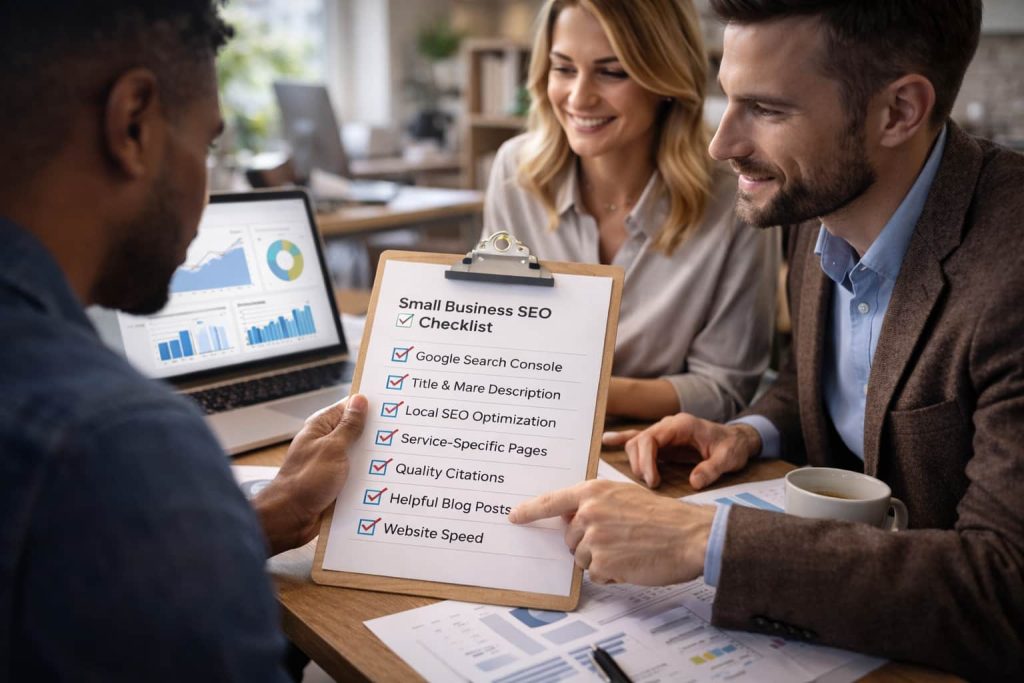
Small Business SEO Checklist
For business owners who want to start improving their search presence immediately, the following checklist highlights some of the most impactful foundational actions.
Set up Google Search Console
This tool allows you to monitor search performance, identify indexing issues, and understand which queries bring visitors to your website.
Optimize your homepage title and meta description
Clear, keyword-focused titles and descriptions help both users and search engines understand what your business offers.
Create service-specific landing pages
Instead of listing all services on a single page, create dedicated pages for each core offering to improve relevance and search visibility.
Implement local SEO optimization
Ensure your Google Business Profile is fully optimized and your business information is consistent across directories.
Build quality local citations
Listing your business in reputable directories helps strengthen local search signals and improves credibility.
Publish helpful blog content regularly
Consistently publishing educational or problem-solving content helps attract informational searches and build topical authority.
Improve website speed and performance
Fast-loading websites improve user experience and can positively influence search rankings.
Track keyword rankings and traffic growth
Regularly monitoring performance ensures your SEO strategy continues moving in the right direction.
Conclusion: Turn Search Into Sales
SEO marketing for small businesses is not about chasing search engine algorithms or manipulating rankings. At its core, it is about connecting your business with people who are actively searching for the services or solutions you provide.
When the right strategy is implemented, SEO becomes one of the most powerful growth channels available to smaller companies. It allows businesses with limited marketing budgets to compete intelligently, attract qualified prospects, and build long-term digital authority.
With consistent optimization, valuable content, and a clear understanding of search intent, even a small company can generate meaningful visibility in competitive markets.
If you want to understand how SEO could specifically impact your business, the best first step is a clear assessment of your current search presence.
A professional SEO strategy consultation can identify opportunities, uncover missed keywords, and outline a realistic roadmap for growth.
Frequently Asked Questions (FAQ)
How long does SEO take for small businesses?
Most small businesses start seeing noticeable improvements within 3–6 months, depending on competition, website quality, and SEO strategy.
What is the average SEO cost for small businesses?
Professional SEO services usually range between £800 and £2,000 per month, depending on the scope of work and competition in your industry.
Can I do SEO myself?
Yes. Many business owners start with DIY SEO, but consistent results usually require experience, time, and advanced tools.
Is local SEO necessary for small businesses?
Yes. If your business serves specific locations, local SEO is essential to appear in Google Maps and local search results.