

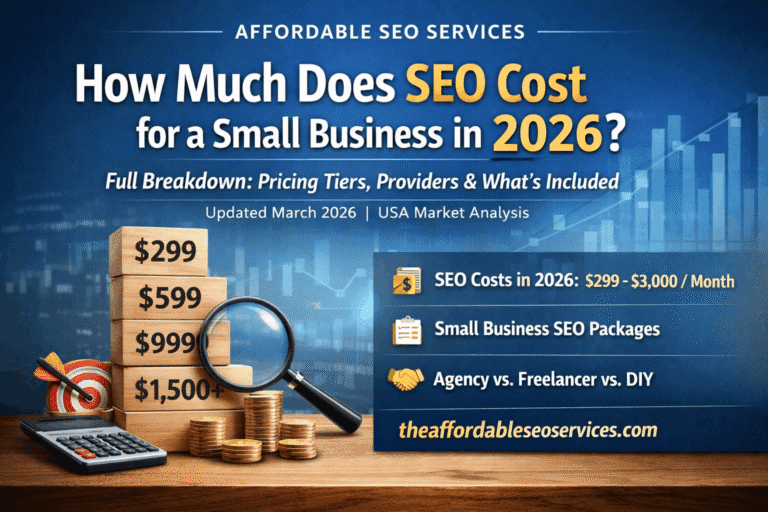
SEO is no longer a luxury it’s one of the smartest long-term investments a business can make. But one question continues to come up: How much does SEO actually cost in 2026?
The truth is there isn’t a one-size-fits-all answer. SEO pricing depends on your industry, competition, business goals and the level of expertise you need. Whether you’re a small local business or a fast-growing enterprise understanding what you’re paying for is the first step toward making a profitable investment.
In this guide we’ll break down the latest SEO pricing models, average costs and the key factors that influence your budget. By the end, you’ll know exactly what to expect and how to choose an SEO service that delivers real measurable results instead of empty promises.
Average SEO Cost in 2026

One of the first questions businesses ask before investing in SEO is, “How much should I expect to pay?” While there’s no universal price tag, understanding the average cost of different SEO services can help you set realistic expectations and avoid offers that seem too good to be true.
SEO pricing in 2026 varies significantly depending on the scope of work, the competitiveness of your industry, the size of your website and the experience of the SEO provider. A local business targeting one city will naturally require a smaller budget than an enterprise company competing in multiple countries and languages.
SEO isn’t simply another marketing expense it’s a long-term growth strategy that delivers compounding results over time. When paired with a well-planned Social Media Marketing Strategy for Small Businesses businesses can increase brand visibility, attract highly targeted audiences, and create multiple channels for sustainable customer acquisition. The cost of SEO reflects the expertise, research, technical implementation, content creation, link building, reporting, and ongoing optimization required to achieve consistent organic growth.
Businesses should focus on value rather than choosing the cheapest provider. An experienced SEO agency may charge more upfront, but it often delivers higher-quality strategies, faster execution and a stronger return on investment over time. On the other hand, extremely low-cost SEO packages frequently rely on outdated tactics, automated content, or spammy backlinks that can harm your website in the long run.
The table below provides a realistic overview of average SEO pricing in 2026 based on current market trends. Keep in mind that these figures represent typical price ranges, and your actual investment may vary depending on your business goals and project complexity.
| SEO Service | Average Price (USD) | Best For | What’s Typically Included |
|---|---|---|---|
| Hourly SEO Consulting | $100 – $300 per hour | Businesses needing expert guidance or short-term consulting | Technical advice, SEO audits, strategy sessions, issue troubleshooting, and roadmap planning. |
| Monthly SEO Services | $1,000 – $5,000+ per month | Most small and medium-sized businesses | Keyword research, technical SEO, content optimization, on-page SEO, link building, reporting, and ongoing improvements. |
| Local SEO | $500 – $2,500 per month | Local businesses targeting a specific city or region | Google Business Profile optimization, citation management, local content, review strategy, and map ranking improvements. |
| Ecommerce SEO | $2,500 – $10,000+ per month | Online stores with dozens or thousands of products | Category optimization, product SEO, technical fixes, internal linking, schema markup, faceted navigation optimization, and content strategy. |
| Enterprise SEO | $5,000 – $25,000+ per month | Large brands and enterprise websites | Technical SEO at scale, international SEO, automation, governance, advanced reporting, and collaboration across multiple teams. |
| One-Time SEO Audit | $500 – $7,500 | Businesses looking to identify SEO issues before starting a campaign | Comprehensive website analysis, technical recommendations, content review, backlink evaluation, competitor analysis, and prioritized action plan. |
Rather than choosing an SEO provider based solely on price consider what you’re actually receiving for your investment. A comprehensive SEO campaign involves far more than optimizing a handful of keywords it requires continuous research, content development, technical maintenance, performance tracking and strategic decision-making. Businesses that invest in quality SEO often see compounding results over time making it one of the highest-return digital marketing channels available in 2026.
SEO Pricing Models Explained: Which Payment Model Is Right for Your Business?

Not every SEO provider charges the same way. Some agencies work on a monthly retainer, while others bill by the hour or charge a fixed project fee. Understanding these pricing models will help you choose an option that aligns with your budget, business goals and long-term growth strategy.
Monthly SEO Retainer: The Best Choice for Sustainable Growth
A monthly retainer is the most common pricing model because SEO is an ongoing process rather than a one-time task. Instead of making a few changes and walking away your SEO team continuously improves your website by publishing content, fixing technical issues, building authority, monitoring competitors and adapting to search engine updates.
This model is ideal for businesses that want consistent organic growth and predictable monthly costs. Since SEO results compound over time, companies that stay committed to a long-term strategy often achieve stronger rankings and a better return on investment.
The only downside is that meaningful SEO results rarely happen overnight. Most businesses begin to see significant improvements after several months, making this model better suited for companies willing to invest in long-term success rather than quick wins.
Hourly SEO Consulting: Flexible Support When You Need It
If you already have an in-house marketing team but need expert guidance for specific challenges, hourly SEO consulting can be a cost-effective solution. Instead of paying for a full-service campaign, you only pay for the time required to solve technical problems, review your strategy or receive professional recommendations.
This pricing model works well for website migrations, technical audits, training sessions and one-off consultations. However, because the work is usually limited in scope, it doesn’t provide the ongoing optimization required to achieve sustained organic growth.
Project-Based SEO: Perfect for One-Time Improvements
Some businesses only need a specific SEO project completed, such as a technical audit, keyword research, website migration, or on-page optimization. In these situations, a project-based pricing model offers a fixed cost with clearly defined deliverables.
This approach gives businesses a predictable budget and is ideal for websites that need a focused improvement rather than continuous optimization. However, once the project is complete, additional SEO work typically requires a new agreement, meaning long-term growth may slow without ongoing support.
Performance-Based SEO: High Risk, High Expectations
Performance-based SEO sounds attractive because payment is tied to results, such as rankings, traffic, or leads. While this model appears low-risk, it often comes with hidden challenges.
Because search rankings depend on hundreds of factors beyond an agency’s control, many providers either charge higher fees, target low-value keywords, or use aggressive tactics to achieve short-term gains. Businesses should carefully review how “performance” is measured before signing any agreement.
Hybrid SEO Pricing: Combining Strategy with Flexibility
A hybrid pricing model combines two or more pricing structures typically a monthly retainer with project-based work or hourly consulting. This allows businesses to receive continuous SEO support while also budgeting for larger initiatives such as website redesigns, content expansion or technical migrations.
For growing companies, this model offers the flexibility to scale SEO efforts without changing providers every time a new project arises. It provides the stability of ongoing optimization while giving businesses the freedom to invest more when opportunities for growth appear.
Which SEO Pricing Model Delivers the Best Value?
For most businesses a monthly SEO retainer remains the most effective choice because it supports continuous optimization, adapts to algorithm updates and builds long-term organic visibility. Hourly consulting and project-based SEO are excellent for solving specific problems, while hybrid pricing offers additional flexibility for growing organizations. Regardless of the pricing model you choose, focus on the value, expertise and measurable results your SEO partner can deliver not simply the lowest price.
SEO Cost by Business Size: How Much Should You Budget?

The amount you should invest in SEO depends largely on the size of your business and the level of competition you face. A local service provider with a small website has very different SEO needs than an enterprise managing thousands of pages across multiple markets. Here’s what businesses of different sizes can typically expect.
Small Business SEO
Small businesses usually focus on improving visibility in a local market or targeting a handful of high-intent keywords. Their SEO campaigns often include keyword research, on-page optimization, local SEO, content creation and basic link building.
Typical Monthly Budget: $500–$2,000
This budget is ideal for local businesses, startups and companies looking to generate steady leads without competing on a national scale.
Medium-Sized Business SEO
As a business grows, its website becomes larger and competition increases. SEO strategies often expand to include regular content publishing, technical SEO improvements, advanced competitor analysis and stronger authority building through high-quality backlinks.
Typical Monthly Budget: $2,000–$5,000
This investment helps growing businesses compete in regional or national search results while maintaining consistent organic growth.
Large Business SEO
Large companies typically manage hundreds of pages, multiple products or services and highly competitive keywords. Their SEO campaigns require a dedicated strategy that combines technical optimization, large-scale content production, digital PR and continuous performance monitoring.
Typical Monthly Budget: $5,000–$10,000+
This level of investment is designed for businesses that rely heavily on organic traffic as a primary source of leads and revenue.
Enterprise SEO
Enterprise organizations face the most complex SEO challenges, including international websites, multiple stakeholders, thousands of landing pages and frequent technical changes. These campaigns often involve automation, advanced reporting, schema implementation and cross-department collaboration.
Typical Monthly Budget: $10,000–$25,000+
For enterprise brands SEO is not simply a marketing expense it’s a long-term growth strategy that requires continuous optimization and significant resources.
Local SEO Pricing: What Does It Cost to Rank in Your Local Market?

If your customers search for businesses near them, Local SEO is one of the highest-return marketing investments you can make. Instead of competing with companies across the country, Local SEO focuses on increasing your visibility in a specific city or service area, helping you attract qualified customers who are ready to take action.
In 2026, most businesses can expect to invest between $500 and $2,500 per month for professional Local SEO services. The final cost depends on factors such as the number of business locations, the competitiveness of your industry and the size of your target market.
Google Business Profile Optimization
Your Google Business Profile is often the first thing potential customers see when searching for local services. A well-optimized profile improves your chances of appearing in the Local Pack and Google Maps results. Professional optimization typically includes updating business information, selecting the right categories, adding high-quality images, publishing regular updates and monitoring profile performance.
Local Citations and Business Listings
Consistency is essential for local search rankings. SEO professionals ensure that your business name, address, phone number and other details remain accurate across trusted online directories. Correcting outdated information and building high-quality citations helps search engines verify your business and improves local credibility.
Review Management and Local Reputation
Customer reviews influence both rankings and purchasing decisions. Local SEO services often include developing a review generation strategy, responding to customer feedback, monitoring online reputation and encouraging satisfied customers to leave authentic reviews. A strong review profile can significantly increase trust and conversion rates.
Google Maps Rankings
Ranking in Google Maps requires more than simply creating a business profile. SEO specialists optimize location relevance, strengthen local authority, improve website signals, build location-focused content and enhance proximity-related factors to increase your visibility for valuable local searches.
Is Local SEO Worth the Investment?
For businesses targeting customers in a specific location, Local SEO is a powerful strategy for improving search visibility and attracting users who are actively looking for nearby products or services. Unlike paid campaigns that generate traffic only while the advertising budget is active, a properly optimized Local SEO strategy creates sustainable growth by increasing organic rankings, strengthening local authority and building long-term customer trust. Alongside SEO efforts, understanding concepts such as Website Design vs Website Development helps businesses create websites that are not only visually appealing but also technically optimized for better user experience, higher conversions and stronger search performance.
Ecommerce SEO Pricing: How Much Does SEO Cost for Online Stores?

Ecommerce SEO is typically more expensive than traditional SEO because online stores have hundreds or even thousands of pages that require continuous optimization. From category pages and product listings to technical improvements and site architecture, every element plays a role in increasing organic traffic and driving sales.
In 2026 most ecommerce businesses invest between $2,500 and $10,000+ per month, depending on the size of the store, the number of products and the competitiveness of the market.
Category Page Optimization
Category pages are often the most valuable landing pages for ecommerce websites because they target high-volume, commercial-intent keywords. Optimizing these pages involves improving metadata, content, internal linking, user experience and keyword targeting to help them rank for competitive search terms while guiding visitors toward the right products.
Product Page SEO
Every product page has the potential to attract highly qualified traffic. SEO specialists optimize titles, descriptions, images, structured data and product content while eliminating duplicate content issues that commonly affect ecommerce websites. Well-optimized product pages not only improve rankings but also increase conversion rates.
Technical SEO for Large Online Stores
As an online store grows, technical SEO becomes increasingly important. Search engines need to crawl and index thousands of pages efficiently, making site speed, Core Web Vitals, XML sitemaps, canonical tags, crawl budget optimization and structured data essential parts of a successful ecommerce SEO strategy.
Faceted Navigation Optimization
Filters for size, color, brand, price and other attributes improve the shopping experience, but they can also create thousands of duplicate URLs. Properly optimizing faceted navigation helps search engines understand which pages should be indexed while preventing crawl waste and duplicate content issues that can limit organic performance.
Internal Linking Strategy
A strong internal linking structure helps distribute authority across your website and makes it easier for both users and search engines to discover important pages. Strategic links between categories, subcategories, products and related content improve crawlability, strengthen topical relevance and support higher rankings for valuable commercial keywords.
Is Ecommerce SEO Worth the Cost?
For online stores, SEO is one of the few marketing channels that continues to generate revenue long after the initial investment. While paid advertising stops producing results the moment your budget runs out, a well-executed ecommerce SEO strategy builds sustainable organic traffic, reduces customer acquisition costs and creates long-term growth that compounds over time.
SaaS SEO Pricing: What Should SaaS Companies Expect to Pay?
SEO for SaaS companies is different from traditional SEO. Instead of focusing only on product or service pages, SaaS businesses must compete across every stage of the customer journey from educational blog content and comparison pages to feature pages and bottom-of-the-funnel landing pages. This makes SaaS SEO a long-term strategy that combines technical expertise, content marketing, and conversion optimization.
In 2026 most SaaS companies invest between $3,000 and $15,000+ per month, depending on the competitiveness of their niche, product complexity, and growth goals.
Early-Stage SaaS
New SaaS startups typically focus on building topical authority, publishing educational content, optimizing product pages and targeting low-to-medium competition keywords. The primary goal is to generate qualified organic traffic while establishing trust with potential customers.
Growth-Stage SaaS
As a SaaS business scales, the SEO strategy expands to include comparison pages, solution pages, feature-specific content, backlink acquisition and ongoing technical improvements. At this stage, SEO becomes a major contributor to customer acquisition and reducing paid advertising costs.
Enterprise SaaS
Large SaaS companies often operate globally and compete against established brands with thousands of indexed pages. Their SEO campaigns include international optimization, content at scale, advanced technical SEO, automation, structured data and close collaboration with development and product teams.
Why Is SaaS SEO More Expensive?
Unlike many industries, SaaS companies must educate users before they are ready to buy. This requires creating high-quality content across the entire marketing funnel, optimizing complex websites and continuously improving conversion paths. While the upfront investment is higher, successful SaaS SEO can significantly lower customer acquisition costs and generate predictable, long-term growth.
What Affects SEO Pricing? Key Factors That Determine Your SEO Budget
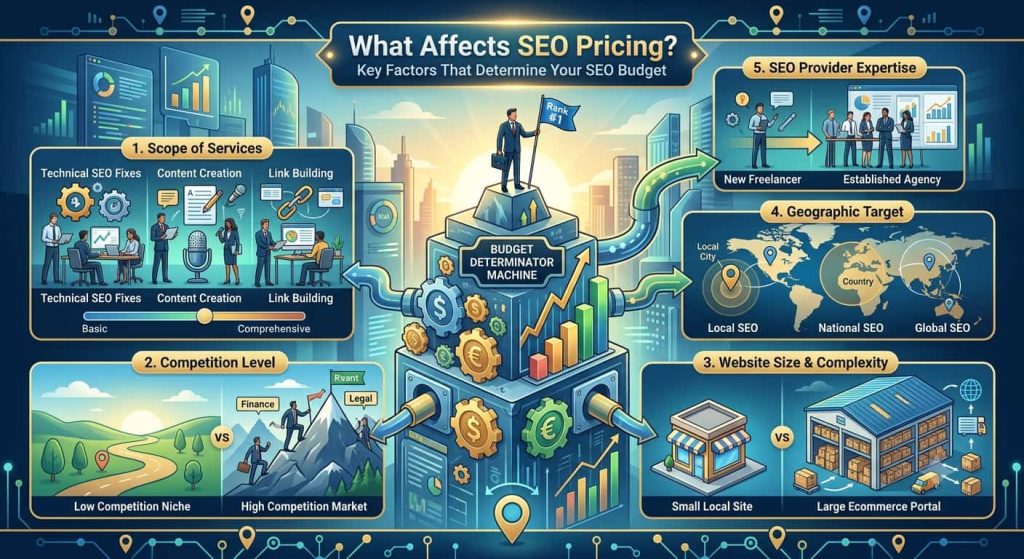
No two SEO campaigns cost exactly the same because every business has different goals, challenges, and levels of competition. While pricing varies between agencies, the following factors have the greatest impact on how much you’ll need to invest.
Competition Level
The more businesses competing for the same keywords, the more resources are required to outperform them. Highly competitive industries demand stronger content, higher-quality backlinks and continuous optimization, which naturally increases SEO costs.
Industry and Niche
Some industries such as legal, healthcare, finance, insurance and SaaS are significantly more competitive than others. These sectors require greater expertise, more authoritative content and stricter quality standards, resulting in higher SEO budgets.
Website Size
A 20-page website requires far less work than an ecommerce store with thousands of products or a large corporate website. More pages mean more technical optimization, content management and ongoing maintenance.
Current Rankings
If your website already ranks on the first or second page of Google, improving those positions is usually faster than building visibility from scratch. New websites often require a larger initial investment to establish authority and trust.
Backlink Profile
Websites with a strong backlink profile generally have a competitive advantage. If your site has few high-quality links—or has been affected by spammy backlinks—additional outreach and link-building efforts may be needed.
Content Requirements
Content is one of the biggest drivers of SEO success. Businesses that need regular blog posts, landing pages, product descriptions or industry guides should expect a higher monthly investment than companies requiring only occasional content updates.
Technical SEO Complexity
Technical issues such as slow loading speeds, poor Core Web Vitals, crawl errors, duplicate content and indexing problems require specialized expertise. The more technical work involved the higher the overall project cost.
Target Location
Optimizing for a single city is generally less expensive than targeting an entire country. Businesses operating in multiple regions or locations require additional landing pages, local optimization, and location-specific strategies.
Language and International SEO
Websites targeting multiple languages or countries require localized content, hreflang implementation, international keyword research and region-specific optimization. These additional tasks increase both complexity and cost.
CMS and Website Platform
The platform your website uses can also affect pricing. Well-optimized CMS platforms like WordPress are often easier to manage, while heavily customized systems may require developer support, increasing implementation time and costs.
Website Migration
If you’re redesigning your website or changing domains, SEO migration is essential to preserve rankings and traffic. Redirect planning, URL mapping, technical validation, and post-launch monitoring all add to the project scope.
Google Penalty Recovery
Recovering from a manual action or algorithmic penalty is one of the most complex SEO services. It often involves identifying harmful backlinks, fixing technical and content issues, rebuilding trust, and monitoring performance over several months.
The Bottom Line
SEO pricing isn’t based on a fixed formula—it’s based on the amount of work required to achieve your goals. A simple local campaign may require only a modest monthly budget, while a national or international SEO strategy demands a much larger investment. The best approach is to choose an SEO plan that matches your business objectives rather than focusing solely on the lowest price.
Cheap SEO vs. Professional SEO: What’s the Real Difference?
Choosing an SEO provider based on price alone can be a costly mistake. While low-cost SEO packages may seem attractive, they often prioritize shortcuts over sustainable growth. Professional SEO, on the other hand, focuses on building long-term organic visibility through proven strategies and continuous optimization.
The biggest difference isn’t simply the monthly fee—it’s the quality of the work, the expertise behind the strategy, and the long-term results you can expect. A reputable SEO agency invests time in understanding your business, analyzing competitors, creating valuable content, improving technical performance, and earning high-quality backlinks. These efforts take time, but they create lasting results that continue to generate traffic and revenue.
Cheap SEO providers often promise fast rankings at an unrealistically low price. In many cases, this involves outdated tactics such as keyword stuffing, low-quality backlinks, automated content, or generic optimization that provides little long-term value. While these methods may produce short-term improvements, they can also increase the risk of ranking losses or search engine penalties.
Professional SEO is built around sustainable growth. Instead of chasing quick wins, experienced agencies develop customized strategies that align with your business goals, adapt to algorithm updates, and focus on measurable performance over time.
Ultimately, SEO should be viewed as an investment rather than an expense. Paying more for experienced professionals often leads to higher-quality traffic, stronger brand authority, and a significantly better return on investment.
What’s Included in Professional SEO Services?
Many business owners ask the same question before hiring an SEO agency: What am I actually paying for? The answer depends on your goals, but a professional SEO campaign typically includes a combination of strategy, technical improvements, content optimization, and ongoing performance analysis.
SEO Strategy and Keyword Research
Every successful campaign starts with understanding how your customers search online. SEO specialists research valuable keywords, analyze competitors, identify ranking opportunities, and create a roadmap that targets both short-term wins and long-term growth.
On-Page SEO Optimization
On-page SEO focuses on improving the pages already on your website. This includes optimizing titles, meta descriptions, headings, URLs, internal links, images, and content to help search engines better understand each page while improving the user experience.
Technical SEO
A technically healthy website provides a strong foundation for higher rankings. Professional SEO services often include improving site speed, fixing crawl errors, optimizing Core Web Vitals, implementing structured data, resolving indexing issues, and ensuring search engines can efficiently access your content.
Content Strategy and Content Creation
Content remains one of the strongest ranking factors in SEO. Agencies typically develop content strategies based on search intent and create high-quality blog posts, landing pages, service pages, category content, and other resources that attract qualified visitors throughout the buying journey.
Link Building
High-quality backlinks continue to play a major role in search rankings. Professional agencies focus on earning authoritative links through outreach, digital PR, partnerships, and valuable content instead of relying on spammy link schemes that could harm your website.
Performance Tracking and Reporting
SEO is an ongoing process that requires continuous monitoring. Most agencies provide regular reports covering keyword rankings, organic traffic, conversions, technical improvements, and completed tasks, allowing you to clearly measure progress and ROI.
What Should You Expect?
A professional SEO service isn’t limited to a checklist of individual tasks. It combines strategy, execution, analysis, and continuous improvement to help your business grow consistently in organic search. When evaluating an SEO provider, focus on the overall value they deliver rather than the number of services listed in a proposal.
SEO Pricing by Country: How Costs Vary Around the World
SEO pricing differs significantly from one country to another. Labor costs, market competition, local demand, and the experience level of SEO professionals all influence how much businesses pay for SEO services.
In highly competitive markets such as the United States, agencies generally charge premium rates because businesses compete for valuable keywords with significant commercial intent. Countries like the United Kingdom, Canada, and Australia follow similar pricing structures due to comparable levels of competition and digital marketing maturity.
Businesses operating in Europe often experience varying prices depending on the country and language requirements. Markets that require multilingual SEO typically involve additional localization work, increasing the overall cost of the campaign.
In contrast, businesses working with agencies in regions such as Eastern Europe, Asia, or the Middle East may find lower hourly rates. However, pricing should never be the only deciding factor. The agency’s experience, portfolio, communication, reporting standards, and proven results are far more important than geographic location alone.
For international businesses, many companies choose agencies based on expertise rather than country. A skilled SEO team with experience in your industry can often deliver greater value regardless of where they are located.
Should You Hire a Local or Overseas SEO Agency?
The best SEO partner is not necessarily the closest or the cheapest—it’s the one that understands your target audience, competitive landscape, and business objectives. Before making a decision, evaluate case studies, client testimonials, communication quality, and reporting processes to ensure you’re investing in long-term success rather than simply reducing costs.
Is SEO Worth the Investment? Understanding SEO ROI
One of the biggest advantages of SEO is that it continues generating traffic long after the initial work has been completed. Unlike paid advertising, where visibility disappears as soon as your budget runs out, SEO builds long-term organic assets that can deliver leads and sales for years.
Imagine a business investing $3,000 per month in SEO. If that campaign generates an additional 5,000 qualified visitors each month, and just 2% of those visitors become customers, the business gains 100 new customers. Even with a modest average customer value, the return can significantly exceed the monthly SEO investment.
Of course, SEO ROI depends on several factors, including your industry, conversion rate, customer lifetime value, and the competitiveness of your market. Businesses with higher-value products or recurring revenue models often see even greater long-term returns from organic search.
SEO Is a Long-Term Asset
Unlike many marketing channels, SEO compounds over time. Every optimized page, high-quality backlink, and valuable piece of content strengthens your website’s authority. As your rankings improve, customer acquisition costs often decrease while organic traffic continues to grow.
For businesses focused on sustainable growth, SEO is not simply a marketing expense—it’s an investment that continues to produce value long after the initial work has been completed.
Final Thoughts: Invest in SEO, Not Just a Price Tag
SEO pricing in 2026 isn’t about finding the cheapest package—it’s about choosing the right strategy for your business goals. Whether you’re a local business, an ecommerce brand, or a growing SaaS company, the cost of SEO should be viewed as an investment in long-term visibility, sustainable traffic, and consistent revenue growth.
As you’ve seen throughout this guide, SEO costs can vary widely based on your industry, competition, website size, and the services included. While lower-priced packages may seem appealing, they often deliver limited results or rely on outdated tactics that can hurt your website over time. A well-planned SEO strategy, backed by experienced professionals, creates lasting value by improving your rankings, attracting qualified visitors, and increasing conversions month after month.
The best approach is to choose an SEO partner that understands your business, provides a transparent strategy, and focuses on measurable outcomes rather than unrealistic promises. Before making a decision, compare what’s included in each proposal, ask the right questions, and ensure you’re investing in a solution that supports your long-term growth—not just your short-term budget.
If you’re unsure how much SEO your business actually needs, start with a professional SEO audit or a personalized consultation. Understanding your current opportunities and challenges is the fastest way to build a strategy that fits your goals and maximizes your return on investment.
Ready to grow your organic traffic? Contact our SEO experts today for a free consultation and receive a customized SEO strategy and pricing plan tailored to your business.