

Building high-quality backlinks has always been one of the most challenging parts of SEO. Creating useful content is relatively straightforward. Getting other websites to recognize that content, trust it, and link to it is a completely different challenge.
For years, marketers have relied on guest posting as one of the most accessible ways to build backlinks. By contributing valuable articles to relevant third-party websites, businesses can earn contextual links while also reaching new audiences.
However, the link-building landscape has changed significantly. Search engines have become better at identifying manipulative link-building patterns, while users and publishers increasingly value originality, authority, and genuine expertise. As a result, another strategy has gained considerable attention: Digital PR.
Digital PR takes a different approach. Instead of primarily trying to place a link inside an article, the goal is to create something genuinely interesting enough that journalists, publishers, bloggers, and industry websites want to talk about it and reference it. This creates an important question for businesses investing in SEO:
Is Digital PR better than Guest Posting, or should you use both?
The answer depends on your objectives, resources, industry, website authority, and the type of links and visibility you want to build.
In this guide, we will compare Digital PR and Guest Posting from an SEO and digital marketing perspective. You will learn how each strategy works, where they differ, what their advantages and disadvantages are, how they affect backlinks and brand authority, how much they can cost, and when each approach makes the most sense.
By the end, you should have a much clearer understanding of whether your business should prioritize Digital PR, Guest Posting, or a combination of both.
What Is Digital PR?
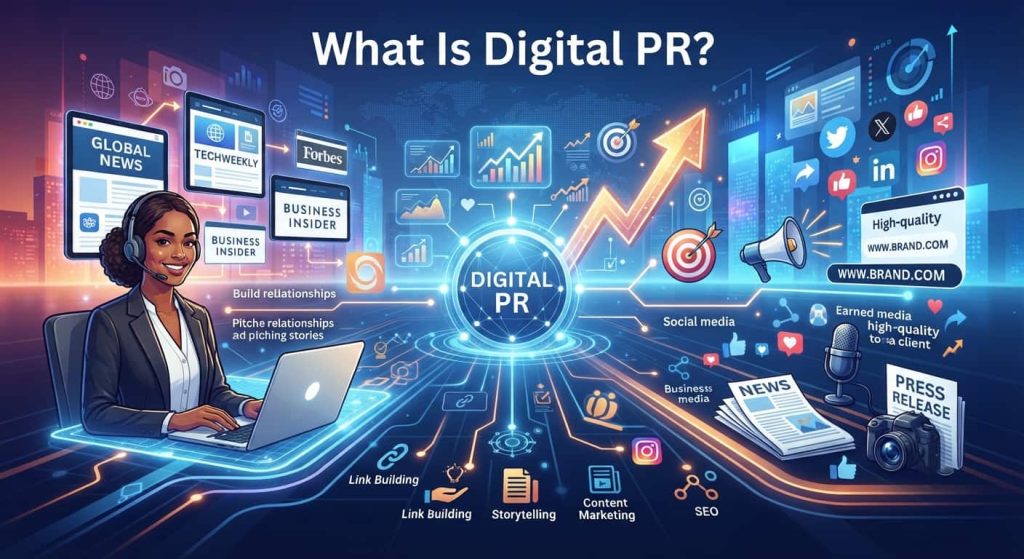
Digital PR is a marketing strategy that combines traditional public relations with digital marketing, content marketing, SEO, and online media outreach. The fundamental idea is simple: create something valuable, interesting, newsworthy, or useful enough that other websites and media organizations want to mention it.
Unlike traditional link building, Digital PR does not necessarily begin with the question, “Where can we get a backlink?” Instead, it begins with a more audience-focused question:
What can we create that people will genuinely want to talk about or reference? A Digital PR campaign might involve original research, industry statistics, expert commentary, surveys, interactive tools, original data, reports, trend analysis, or a creative campaign designed around a specific story.
When successful, the campaign can attract coverage from publishers, industry websites, journalists, blogs, and other authoritative sources.
How Does Digital PR Work?
A typical Digital PR campaign starts with an idea. The idea needs to have a reason for existing beyond simply generating backlinks. For example, a marketing agency might conduct a survey of 1,000 small business owners to understand how companies are using AI in their marketing strategies.
The agency could then turn the results into a detailed report containing original statistics and insights. The next stage is identifying the people and publications that would find those findings relevant.
A strong digital PR campaign starts by identifying journalists and publishers who regularly cover topics such as marketing, technology, artificial intelligence, entrepreneurship, and small business. Rather than sending a generic link-building request, the outreach should position original research or valuable data as a credible source for a potential story. When a journalist references the research, the brand can earn both a meaningful mention and a relevant backlink. This approach focuses on creating genuine editorial value first, with links becoming a natural result of the coverage. Combined with strategies such as How to Generate More Qualified Leads With Digital Marketing digital PR can also help businesses attract a more relevant audience and strengthen their overall online visibility.
What Makes a Digital PR Campaign Successful?
Successful Digital PR usually depends on three elements: the quality of the idea, the relevance of the story, and the quality of the outreach. A campaign can contain excellent data and still fail if nobody cares about the topic. Similarly, an interesting story may receive little coverage if it is presented to the wrong journalists.
This is why Digital PR requires much more than producing content. It involves understanding audiences, media interests, news cycles, editorial preferences, and the specific reasons a publisher might consider a story worth covering.
The strongest campaigns usually provide something that publishers cannot easily obtain elsewhere. Original data is particularly powerful because journalists can use it as evidence in their own articles. Expert commentary can also be valuable because it gives publishers access to a credible source. The goal is therefore not simply to create a page that deserves a backlink. It is to create an asset that becomes useful to other people.
What Is Guest Posting?
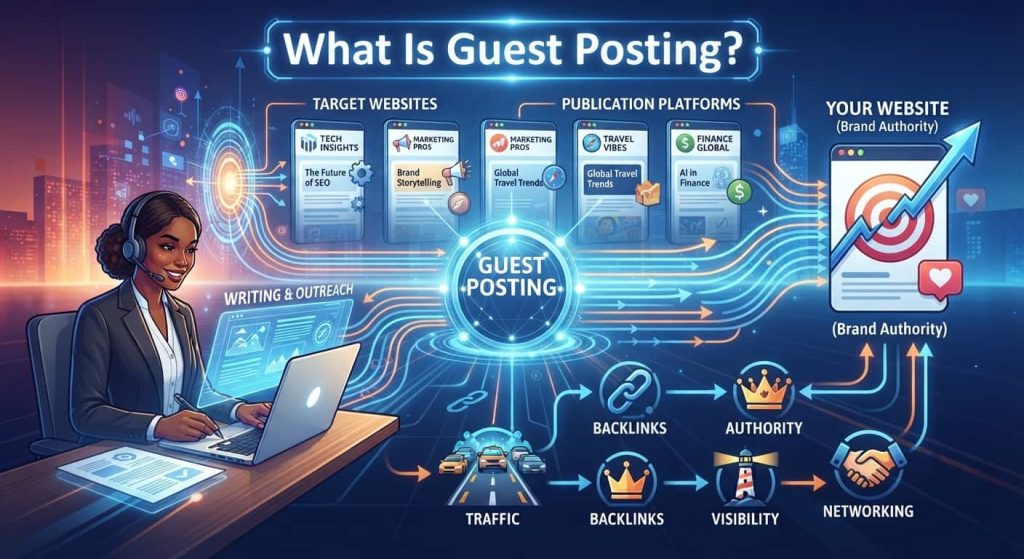
Guest Posting, also known as Guest Blogging, is the practice of writing and publishing an article on another website.
The contributor typically creates an article that is relevant to the target publication’s audience. In return, the publisher may allow the contributor to include a link to their website, usually within the author bio or naturally within the article when appropriate.
Guest Posting has been widely used in SEO because it provides a relatively direct way to earn contextual backlinks. For example, imagine that a company provides SEO software. The company could contribute an article about technical SEO to a reputable marketing website. Within the article, it may naturally reference a relevant resource on its own website.
The result is potentially valuable for both audiences. The publisher receives useful content, while the contributor gains exposure and potentially a relevant backlink.
How Does Guest Posting Work?
The process generally begins with identifying websites that are relevant to the business or topic. A company might look for marketing publications, industry blogs, professional associations, specialist websites, or other authoritative resources.
The next step is outreach. The contributor contacts the website owner or editor with a content proposal. If the publisher is interested, both sides may discuss the topic, editorial requirements, formatting, and potential references.
The article is then written according to the publication’s standards.
The most important factor is relevance. A backlink from a website that has no meaningful relationship with your industry may provide less value than a link from a smaller but highly relevant publication.
For example, a backlink from a respected cybersecurity publication could be highly relevant to a cybersecurity company. A link from an unrelated website simply because it has a high domain authority metric is a very different proposition.
What Makes Guest Posting Effective?
Guest Posting works best when it is treated as a publishing and relationship-building strategy rather than a backlink production system. The strongest guest contributions provide genuine value to the publication’s audience.
They answer a specific question, provide expert insight, explain a complex concept, or offer original perspectives. Problems tend to arise when marketers focus almost entirely on link acquisition.
Publishing large numbers of low-quality articles on weak websites can create an unnatural backlink profile and may associate a brand with low-quality publishing networks. Quality should therefore be more important than volume.
A single well-written article on a respected industry publication can be considerably more valuable from a marketing perspective than dozens of thin articles published on websites that exist primarily to sell links.
Digital PR vs Guest Posting: What Is the Difference?
Although both strategies can generate backlinks and referral traffic, they are fundamentally different approaches to link acquisition. Guest Posting is generally a controlled publishing strategy. You create the content, pitch the publication, agree on the topic, and participate directly in the publication process.
Digital PR is more dependent on earned attention. You create an asset or story and attempt to convince journalists and publishers that it deserves coverage. This difference affects almost everything else, including predictability, scalability, cost, control, and the types of links you can earn.
Digital PR Is Earned Media
The defining characteristic of Digital PR is earned media. You do not necessarily control where the campaign gets mentioned or exactly which pages link to you.
A journalist might discover your research through an outreach email and cite it in a national publication. Another publisher might discover the same research independently and reference it several weeks later.
This lack of control can make Digital PR unpredictable. However, it can also create opportunities that would be difficult to achieve through traditional outreach. One successful campaign can potentially generate coverage across multiple publications without requiring you to negotiate each individual placement.
Guest Posting Offers More Control
Guest Posting generally provides much greater control. You choose the publication you want to target. You propose the topic. You write the article. You can often determine where a relevant reference should appear.
This makes Guest Posting particularly useful when your objective is to build topical relevance around specific pages or subjects. For example, a SaaS company trying to strengthen its authority around “marketing automation” may contribute detailed articles to several relevant marketing publications. The company can create content that supports its broader topical strategy while naturally referencing useful resources on its own website.
Digital PR vs Guest Posting: Key Differences
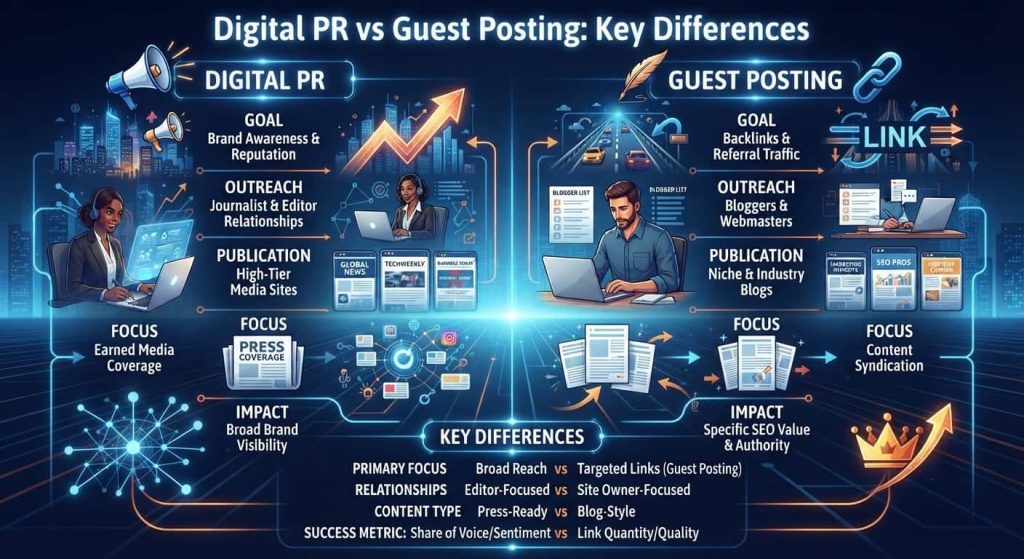
The biggest difference between these strategies is not simply how backlinks are obtained. It is the philosophy behind the acquisition process. Digital PR is primarily about earning attention.
Guest Posting is primarily about earning publishing opportunities. Both can be legitimate and effective when executed properly, but they require different skills and resources.
Purpose
Digital PR is usually designed to generate a combination of backlinks, media coverage, brand awareness, referral traffic, and authority. Guest Posting is generally more focused on publishing useful content on relevant third-party websites while building relationships and earning contextual mentions. This does not mean Guest Posting cannot generate brand awareness or Digital PR cannot generate backlinks. The difference is where the strategy places its primary emphasis.
Level of Control
Guest Posting offers greater control because the contributor is directly involved in the publishing process. Digital PR offers less control because journalists and publishers decide whether they want to cover the story. This makes Guest Posting easier to plan from a campaign-management perspective. Digital PR, however, can create much larger outcomes when a campaign gains significant media attention.
Scalability
Guest Posting can be scaled through systematic outreach, content production, and publisher relationships. However, quality becomes increasingly difficult to maintain as volume increases.
Digital PR can also scale, but not necessarily through publishing more articles. Instead, scaling usually means developing multiple campaigns, angles, datasets, or creative assets that can attract different groups of publishers. This makes Digital PR more dependent on creativity and research.
Brand Exposure
Digital PR generally has a stronger branding component. A successful campaign may expose a company to thousands or even millions of potential readers who have never heard of the brand.
Guest Posting can also introduce a brand to new audiences, but the exposure is usually concentrated around the specific publications where the articles appear.
Editorial Value
Digital PR often produces highly editorial backlinks because journalists decide independently that a source is worth referencing. Guest Posting can also produce editorially valuable links when the article is genuinely useful and the link is contextually appropriate.
The distinction is therefore not that every PR link is automatically good and every guest post link is bad. The quality of the publication, relevance of the link, editorial standards, and purpose of the content all matter.
Digital PR and Guest Posting: Are They Still Relevant for SEO?
Both strategies can play a role in a modern SEO campaign, but neither should be approached as a shortcut for manipulating rankings. Search engines have become considerably better at evaluating link patterns, content quality, and overall website credibility. A sustainable link-building strategy should therefore focus on relevance, usefulness, authority, and natural acquisition rather than simply increasing the number of referring domains.
Why Link Quality Matters More Than Link Quantity
A common mistake in SEO is assuming that more backlinks automatically produce better rankings.That assumption is too simplistic.
A website with hundreds of irrelevant or low-quality links may be less credible than a website with a smaller number of highly relevant, trustworthy references.
Consider two hypothetical websites. The first has 500 backlinks from unrelated blogs with little editorial oversight. The second has 50 links from respected publications, industry resources, and relevant websites. The second profile may provide considerably stronger signals of genuine authority. This is why modern link building should focus on earning references that make sense within the context of the web.
Relevance Is a Critical Factor
Relevance is one of the most important considerations when evaluating a backlink. A marketing agency should ideally earn links from websites related to marketing, business, technology, entrepreneurship, or closely connected subjects. A backlink from an unrelated website may have little meaningful relationship with the site’s content.
Guest Posting can be particularly useful for relevance because marketers can deliberately target publications within their niche. Digital PR can also produce highly relevant links when campaigns are designed around industry-specific research or news.
The Biggest Strategic Difference
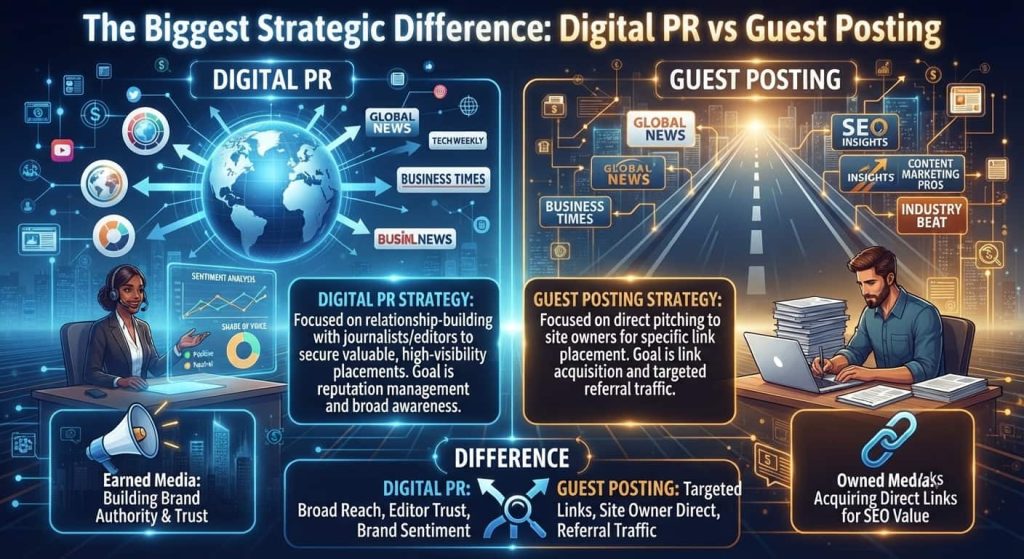
The most important difference between Digital PR and Guest Posting is the way each strategy approaches authority.
Guest Posting says:
- “We have expertise that can contribute value to your audience.”
Digital PR says:
- “We have something interesting, useful, or newsworthy that your audience should know about.”
Neither approach is inherently superior. The better strategy depends on what your business needs. A new SaaS company may benefit from Digital PR because it needs awareness and recognition.
An established B2B company may use Guest Posting to strengthen visibility within a specific niche. An enterprise brand may use both. The most sophisticated SEO campaigns do not treat these strategies as competing alternatives. They use them as complementary components of a broader authority-building strategy.
What Should You Choose?
If your primary objective is brand awareness and high-level media exposure, Digital PR is often the stronger choice. If your primary objective is controlled content placement and niche-specific authority building, Guest Posting may be more practical. If your business has the resources to do both, combining them can create a stronger and more diversified strategy.
The key is to avoid treating either tactic as a simple backlink acquisition machine. Links are valuable, but the broader objective should be to build a website and brand that people genuinely want to reference.
Digital PR vs Guest Posting: Which One Has a Bigger SEO Impact?
The real value of a link-building strategy cannot be measured simply by counting how many backlinks it generates. What matters is where those links come from, why they exist, how relevant they are, and whether they contribute to the broader authority and visibility of a website.
Both Digital PR and Guest Posting can contribute to SEO, but they do so through different mechanisms.
Guest Posting gives marketers more control over the websites they target and the context in which a link appears. Digital PR, on the other hand, is designed to earn organic mentions and editorial coverage from publishers that find a story, research project, or campaign genuinely useful.
This difference can have a major impact on the type of backlink profile a website develops.
Why Editorial Backlinks Can Be So Valuable
Editorial backlinks are links that appear naturally within content because the publisher considers the referenced source useful to readers. For example, imagine a marketing publication writing an article about the growth of AI in search. The journalist discovers an original research report published by a digital marketing agency and uses one of its statistics in the article, linking back to the original report.
That link is editorial because the publisher chose to reference the source based on its usefulness. Digital PR is particularly effective at generating this type of coverage because the campaign itself is designed to become a source for journalists and publishers.
Guest Posts can also contain editorially valuable links, particularly when the contributor references genuinely useful resources. The important factor is that the link should serve a legitimate purpose for the reader rather than exist solely because someone wanted to manipulate rankings.
Does Digital PR Generate Stronger Backlinks?
Digital PR often has the potential to generate links from highly authoritative media websites. A successful campaign might be referenced by news publications, industry magazines, specialist websites, and influential blogs. However, it would be inaccurate to say that every Digital PR backlink is automatically stronger than every Guest Post backlink.
A highly relevant Guest Post on a respected industry publication can be more valuable than an irrelevant media mention. The correct way to evaluate a backlink is to look at the entire context.
Consider the relevance of the publication, the quality of its content, the credibility of the site, the page where the link appears, the surrounding content, the audience, and whether the link provides genuine value.
This is why the question should not simply be:
- “Which strategy gives me stronger backlinks?”
A better question is:
- “Which strategy helps me earn relevant, credible, and useful references from websites my audience actually trusts?”
Beyond Backlinks: The Hidden SEO Benefits of Digital PR
One of the biggest advantages of Digital PR is that its value does not necessarily stop at the backlink. A strong PR campaign can influence several aspects of a digital marketing strategy simultaneously.
It can increase brand awareness, generate referral traffic, create brand mentions, attract journalists, support future outreach, and establish a company as a source of expertise. These benefits can continue long after the original campaign has been published.
Brand Mentions and Online Visibility
A brand does not need to receive a backlink every time it is mentioned to benefit from increased visibility. When a company repeatedly appears in discussions across reputable publications, more people become familiar with the brand.
This can lead to branded searches, direct visits, social sharing, media opportunities, and future collaborations. For example, if a cybersecurity company becomes known for publishing reliable security research, journalists may begin contacting the company for comments when new cybersecurity stories emerge.
That creates a long-term authority advantage that cannot easily be reduced to the number of backlinks acquired during one campaign.
Referral Traffic Can Become a Secondary Growth Channel
SEO professionals sometimes focus so heavily on rankings that they overlook referral traffic. A link from a major publication can send qualified visitors directly to your website. These visitors may subscribe to a newsletter, explore a service page, download a resource, or become customers.
This is particularly valuable when the referring publication has an audience closely aligned with the target customer. Guest Posting can also generate referral traffic, but the results depend heavily on the popularity and audience engagement of the publishing website. A guest article on a respected publication with an active readership may become a meaningful traffic source.
A guest article on a website that receives almost no real traffic may provide little business value even if the backlink technically exists.
How Guest Posting Supports SEO in a Different Way
Guest Posting has a different strength: control. You can select topics, publications, contextual references, and the overall editorial direction more deliberately. This makes it particularly useful when a business wants to build authority around a specific subject.
Building Topical Relevance Through Guest Content
Imagine that a software company wants to strengthen its visibility around the topic of customer relationship management. Instead of publishing everything on its own website, the company could contribute useful articles to reputable business and technology publications. One article might discuss CRM automation.
Another could explain customer retention strategies. A third could examine CRM analytics. Over time, these external publications can help the company become more visible within its broader industry ecosystem. The important point is that the content should remain useful and relevant rather than becoming a collection of articles created solely to place links.
Contextual Links Can Support Content Discovery
A well-placed contextual link can help users discover additional resources. Suppose an article explains how to perform a technical SEO audit. The author references a detailed technical SEO checklist hosted on another website. The link makes sense because readers who want more detail can follow it.
This is the kind of contextual relationship that makes a backlink useful beyond SEO. The strongest Guest Posting strategies therefore focus on creating a logical connection between the article, the audience, and the linked resource.
Digital PR: The Advantages That Make It Powerful
Digital PR has become an important component of modern authority-building because it can combine SEO, branding, content marketing, and public relations within a single campaign. Its biggest strength is its ability to transform useful information into media attention.
High-Authority Media Exposure
One successful Digital PR campaign can generate coverage across multiple publications. This can create a level of exposure that would be difficult to achieve through individual Guest Posting campaigns.
For example, original research about consumer behavior could be picked up by several publications covering business, technology, finance, or marketing. Each article can introduce the brand to a different audience. This creates a compounding effect.
The original research becomes an asset. The asset generates media coverage. The coverage generates visibility and links. The visibility increases brand recognition. The brand recognition can create additional opportunities. That is one reason Digital PR is often viewed as a long-term authority strategy rather than simply a link-building tactic.
Strong Brand-Building Potential
Guest Posting usually places the contributor inside someone else’s content environment. Digital PR can make the company itself the subject of the story.
That distinction is important. When journalists cite your research, quote your experts, or discuss your findings, the brand becomes part of the narrative.
Over time, repeated exposure can help establish the company as an authority in its industry. This can be particularly valuable for companies operating in competitive markets where brand trust influences purchasing decisions.
Potential for Multiple Links From One Campaign
A strong Digital PR campaign can generate several references from different websites without requiring the company to create a separate article for each publication. This is one of the most attractive characteristics of PR-led link building. The campaign is created once, but its distribution can continue across multiple publishers.
However, this should never be interpreted as a guarantee. Some campaigns receive significant coverage. Others receive very little. The quality of the idea, timing, outreach, newsworthiness, and industry all influence the outcome.
Digital PR: The Challenges You Should Know Before Investing
Digital PR can produce impressive results, but it is not an easy strategy. One of the biggest mistakes businesses make is assuming that publishing a report or sending a few emails to journalists automatically creates media coverage. It does not.
Great Content Does Not Guarantee Media Coverage
A campaign can contain excellent research and still fail. Journalists receive large numbers of pitches every day. They have limited time and constantly changing editorial priorities. A story that seems interesting to a marketer may not be interesting to a journalist. This is why successful Digital PR requires strong campaign ideation.
The question should not only be whether the research is accurate. The question should also be whether the findings are surprising, timely, useful, controversial, relevant, or interesting enough to become part of a story.
Digital PR Can Be Expensive
High-quality Digital PR often requires research, data analysis, design, copywriting, outreach, media relationships, and campaign management. An in-house team may need several specialists to handle these tasks.
Agencies can reduce the internal workload, but professional PR campaigns can require a significant budget. This makes Digital PR less accessible to businesses that are just beginning their SEO journey.
However cost should be evaluated against the total outcome rather than the number of backlinks. If one campaign generates significant media coverage, referral traffic, brand exposure, and high-quality links, its business value may be much greater than the cost of acquiring individual placements.
Guest Posting: The Advantages That Keep It Relevant

Despite the growth of Digital PR, Guest Posting remains useful when approached correctly. Its biggest advantage is predictability. While there is no guarantee that a publisher will accept a contribution, the process is generally easier to plan than a large-scale PR campaign.
More Control Over Topics and Placements
Guest Posting allows marketers to choose publications that are relevant to their industry. They can research the website, understand its audience, propose suitable topics, and create content specifically for that publication.
This level of control can be valuable for businesses with very specific marketing goals. For example, a B2B software company may want exposure among startup founders. Instead of waiting for a PR campaign to attract that audience, it can actively target startup publications and contribute useful content.
Easier to Build a Consistent Publishing Strategy
Guest Posting can be integrated into an ongoing content marketing calendar. A business can identify relevant publications, develop relationships with editors, and gradually increase its presence across the industry. This makes it possible to create a long-term publishing strategy rather than relying on one major campaign.
The key is maintaining editorial quality. Publishing ten excellent contributions over time is usually more valuable than publishing fifty weak articles simply to increase backlink numbers.
Useful for Niche Industries
Not every business has a story that journalists will consider newsworthy. Some industries are highly specialized. A company selling enterprise software for a narrow industrial sector may struggle to create campaigns that attract mainstream media.
Guest Posting can be more practical in such situations. Specialist publications may be genuinely interested in educational content even when mainstream media has little interest in the topic.
Guest Posting: Where Things Can Go Wrong
Guest Posting becomes problematic when the primary objective shifts from publishing useful content to manipulating rankings. This is where quality control becomes critical.
The Problem With Low-Quality Guest Posts
Publishing articles on websites that exist primarily to sell backlinks can create a weak and potentially unnatural link profile. These websites may have little genuine readership, publish content on unrelated topics, accept almost anything, and contain large numbers of outbound commercial links.
Such placements provide limited value to users. A sustainable Guest Posting campaign should therefore prioritize real publications with genuine audiences and meaningful editorial standards.
Over-Optimized Anchor Text Can Be Risky
Another common problem is excessive use of exact-match commercial anchor text. For example a company targeting the keyword “best SEO agency” may attempt to use that exact phrase repeatedly across external articles.
That pattern can look unnatural. Anchor text should generally fit the surrounding context and provide a useful description of the destination page. In many cases, branded, natural, partial-match, or descriptive anchors make more sense than repeatedly forcing the same commercial keyword.
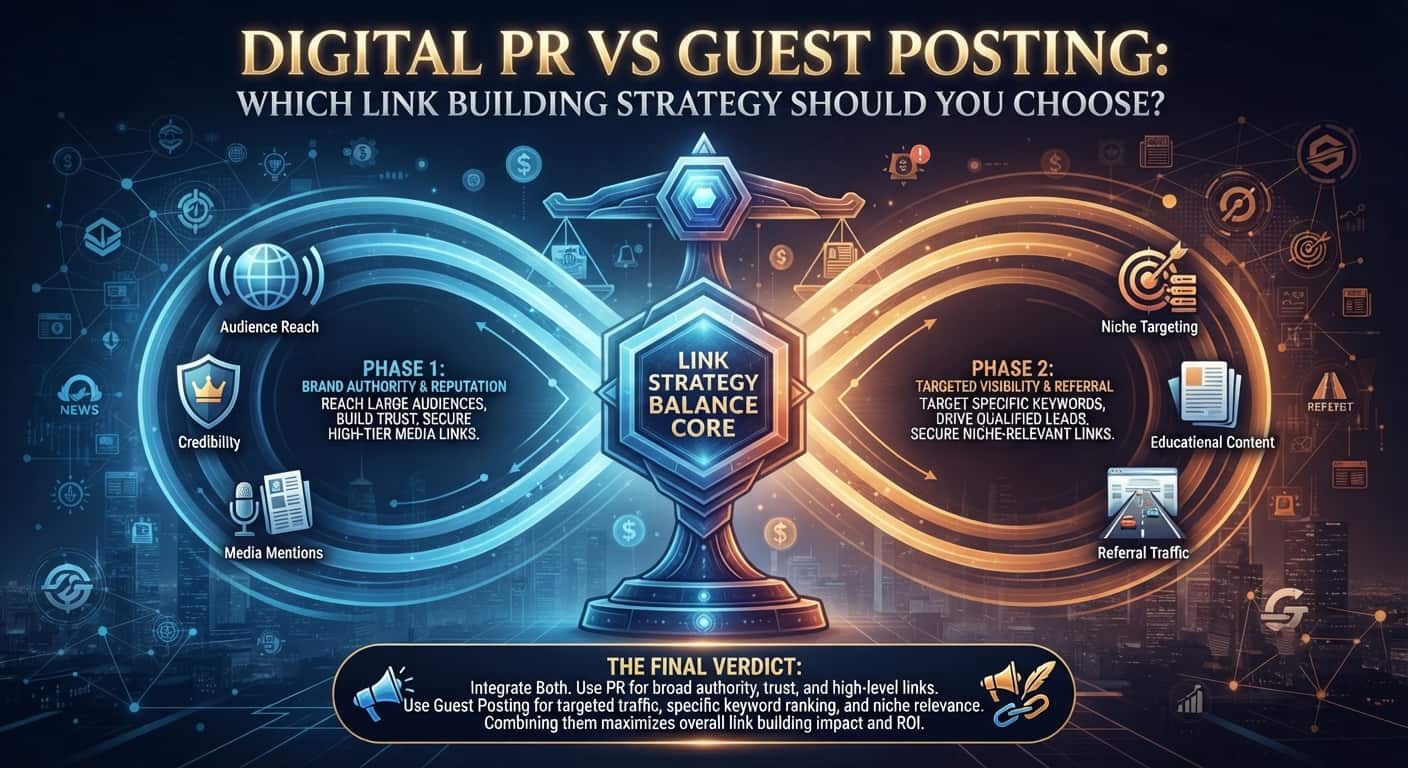
Digital PR vs Guest Posting: Which One Wins?
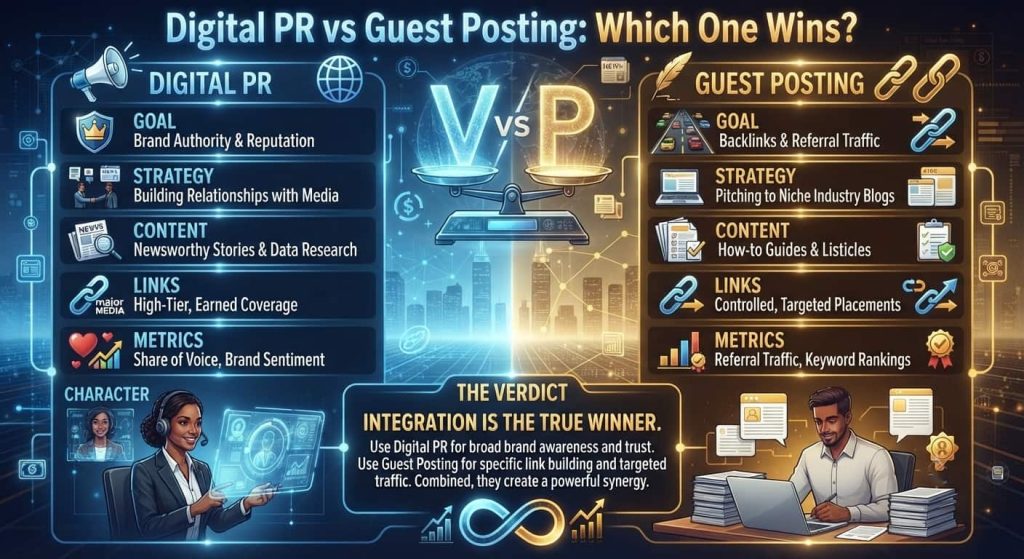
At this point, it should be clear that there is no universal winner. Digital PR has a major advantage when the objective is to generate media exposure, build brand authority, earn editorial coverage, and create a campaign with potential to attract multiple natural references.
Guest Posting has an advantage when the objective is to build relationships with relevant publications, control the content process, reach specific audiences, and develop consistent niche-focused visibility. The strongest approach is often not choosing one and abandoning the other. It is understanding where each strategy fits within the broader SEO campaign.
The Best Strategy May Be a Combination of Both
A mature SEO strategy can use Digital PR to create major authority signals and Guest Posting to maintain consistent industry visibility. For example a company could launch one original research campaign every quarter while contributing high-quality expert articles to relevant publications throughout the year.
The PR campaigns generate newsworthiness and broad exposure. The Guest Posts provide ongoing educational contributions and industry relationships. Together, these tactics can support a more diversified digital presence.
What Should You Prioritize in Your Link Building Strategy?
Before deciding between Digital PR and Guest Posting, look at your actual business objectives. If your website has little brand recognition and you have original data, research, or an interesting story, Digital PR may have enormous potential. If you operate in a specialized niche and need highly relevant industry placements, Guest Posting may be more practical.
If your company has enough resources, combining both strategies can provide the strongest long-term approach. The most important principle is to stop viewing backlinks as isolated SEO objects.
A backlink should ideally represent something meaningful: a useful resource, an expert contribution, a credible research finding, or a piece of content that genuinely deserves to be referenced. That is what makes a link valuable not only to search engines, but also to real people.
The Bottom Line: Build Authority, Not Just Backlinks
Digital PR and Guest Posting are often compared as if one must replace the other. In reality, they solve different problems. Digital PR is about creating something worth talking about.
Guest Posting is about contributing something worth publishing. One relies heavily on earned media attention. The other provides greater control over content and publication opportunities. Both can contribute to a successful SEO strategy when quality, relevance and genuine value remain at the center of the campaign.
The goal should not be to acquire the largest possible number of backlinks. The goal should be to build a website and brand that other people naturally consider trustworthy enough to reference. That shift in mindset is what separates sustainable link building from short-term link acquisition.
How Much Do Digital PR and Guest Posting Actually Cost?
Cost is one of the biggest factors businesses consider when choosing between Digital PR and Guest Posting. However, comparing these strategies purely by price can be misleading because they generate value in different ways.
Guest Posting can often be started with a relatively small budget, especially when a business already has writers and an outreach process in place. Digital PR usually requires more resources because a successful campaign may involve research, data collection, campaign development, design, media outreach, and public relations expertise. The important question is not simply how much each backlink costs.
The better question is:
- How much business value can each strategy generate relative to the investment?
What Determines the Cost of Digital PR?
The cost of a Digital PR campaign depends heavily on the type of campaign being created. A simple expert commentary campaign may require relatively little investment. A large original research campaign can require significantly more.
For example, a research-driven campaign might require a company to conduct a survey, analyze thousands of responses, create visualizations, produce a report, prepare supporting content, and conduct outreach to journalists.
The cost therefore comes from the entire campaign rather than the backlink itself. A professional Digital PR campaign may involve strategists, researchers, writers, designers, data analysts, and outreach specialists. This is one reason Digital PR can appear expensive compared with traditional link-building methods.
However, a successful campaign can generate multiple forms of value simultaneously. It may produce backlinks, brand mentions, referral traffic, media coverage, social exposure, new relationships, and increased brand searches.
What Determines the Cost of Guest Posting?
Guest Posting costs are generally easier to understand. The main expenses usually involve content creation, outreach, relationship management and sometimes editorial or publishing fees.
If the company produces the content internally and works with publications that do not charge for contributions, the direct cost can be relatively low. However, there is another cost that is frequently ignored: time.
Finding relevant websites, researching editors, creating personalized pitches, following up, negotiating topics, writing articles, editing content, and maintaining publisher relationships can require substantial effort. A campaign that appears inexpensive financially may still consume hundreds of hours of internal marketing resources.
Why Cost Per Link Is the Wrong Metric
One of the most common mistakes in link building is calculating success based on cost per backlink. Suppose a company spends $5,000 on a Digital PR campaign and earns ten backlinks.
On the surface, that might appear expensive compared with a Guest Posting campaign that generates twenty links for the same budget. But what if the PR campaign also generates coverage from major publications, thousands of referral visits, significant brand exposure, and new business opportunities?
The number of links alone would not capture the true value. The same principle applies to Guest Posting. A single contribution on an influential industry publication may generate fewer links than a large-scale outreach campaign, but it could introduce the company to exactly the audience it wants to reach. The value of a link should therefore be measured within the context of the entire campaign.
Which Strategy Delivers a Better Return on Investment?
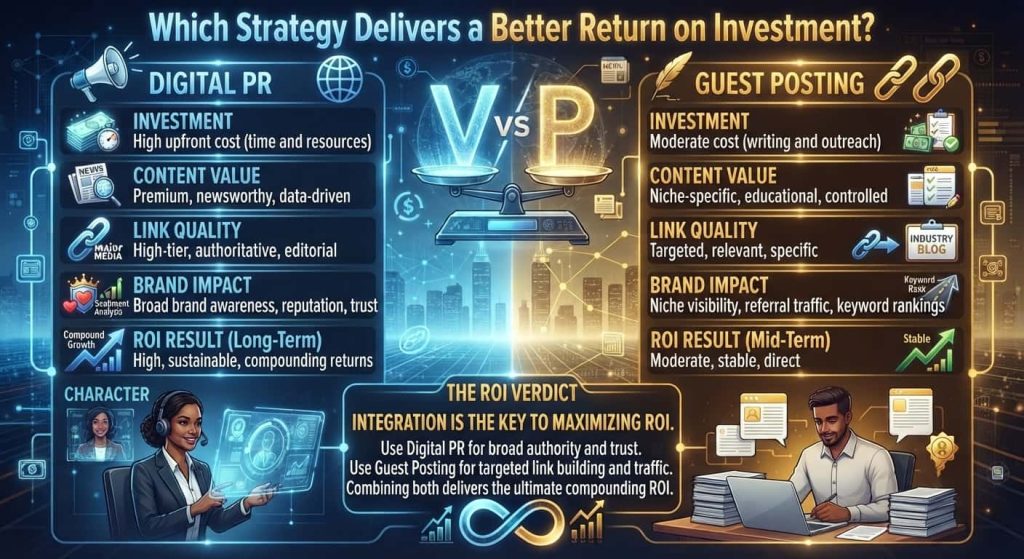
Return on investment is more difficult to measure than simple link acquisition because both Digital PR and Guest Posting can influence several stages of the customer journey. A successful campaign may generate immediate traffic while also contributing to long-term brand recognition and organic visibility. For this reason, businesses should evaluate both direct and indirect returns.
Measuring Digital PR ROI
Digital PR ROI can include much more than backlinks. A company might measure the number and quality of media placements, referral traffic, brand mentions, organic search growth, branded search demand, social engagement, email subscriptions, leads, and conversions.
For example, imagine that an original industry report is covered by several respected publications. Some visitors may click the backlink and arrive directly on the website.
Others may remember the brand and search for it later. Some journalists may contact the company for future commentary. A few readers may eventually become customers. The campaign has therefore influenced multiple parts of the marketing funnel. This makes Digital PR particularly valuable for businesses that care about both SEO and brand growth.
Measuring Guest Posting ROI
Guest Posting ROI can be measured through referral traffic, conversions, assisted conversions, brand exposure, backlinks, keyword visibility, and relationships developed with industry publications. One advantage of Guest Posting is that the target audience can often be selected more precisely.
If a B2B software company publishes an article on a website read by its ideal customers, even a relatively small amount of traffic can be valuable. Ten highly relevant visitors can sometimes be more commercially valuable than hundreds of visitors with no connection to the company’s target market. This is why traffic quality should always be considered alongside traffic volume.
Which Strategy Is Better for Startups?
Startups often face a difficult situation. They need visibility and authority, but they usually have limited budgets and little brand recognition. The right strategy therefore depends on what assets the startup already possesses.
When Digital PR Makes Sense for a Startup
Digital PR can be particularly powerful for startups with something genuinely new to talk about. A new technology, original research project, unusual product, unique dataset, or strong founder story can provide a foundation for PR outreach.
For example, a startup launching an AI product could publish original research about how businesses are adopting AI. The research gives journalists something concrete to reference rather than simply asking them to write about a new company. This can help a relatively unknown brand gain credibility much faster.
When Guest Posting Is More Practical for a Startup
Guest Posting can be more practical when the startup does not yet have a strong PR story. A new company can begin building relationships with niche publications by contributing useful educational content.
This allows the brand to demonstrate expertise before it has enough recognition to attract widespread media attention. For startups with limited resources, a focused Guest Posting strategy targeting a small number of highly relevant publications can be a sensible starting point.
Digital PR vs Guest Posting for SaaS Companies
SaaS companies often have an advantage when it comes to Digital PR because software businesses can generate interesting datasets and research. Product usage data, industry trends, customer surveys, technology adoption statistics, and original studies can all become PR assets.
Why SaaS Brands Can Benefit From Digital PR
A SaaS company often has access to information that can reveal broader market trends. For example, a project management platform could analyze anonymized usage patterns to identify how remote teams collaborate. A marketing platform could publish research about advertising trends.
An analytics company could investigate changes in consumer behavior. These types of insights can become valuable sources for journalists. The company’s product therefore becomes more than a product. It becomes a source of data and expertise.
Why Guest Posting Still Matters for SaaS
Guest Posting can help SaaS brands establish authority around the problems their software solves. A project management platform might contribute articles about productivity, remote work, project planning, and team collaboration. A CRM company could publish educational content about sales automation, customer retention, and lead management.
This creates opportunities to reach highly relevant audiences while reinforcing the brand’s expertise. For SaaS companies, a combination of research-driven Digital PR and expert Guest Posting can be particularly effective.
Which Strategy Works Better for B2B Companies?
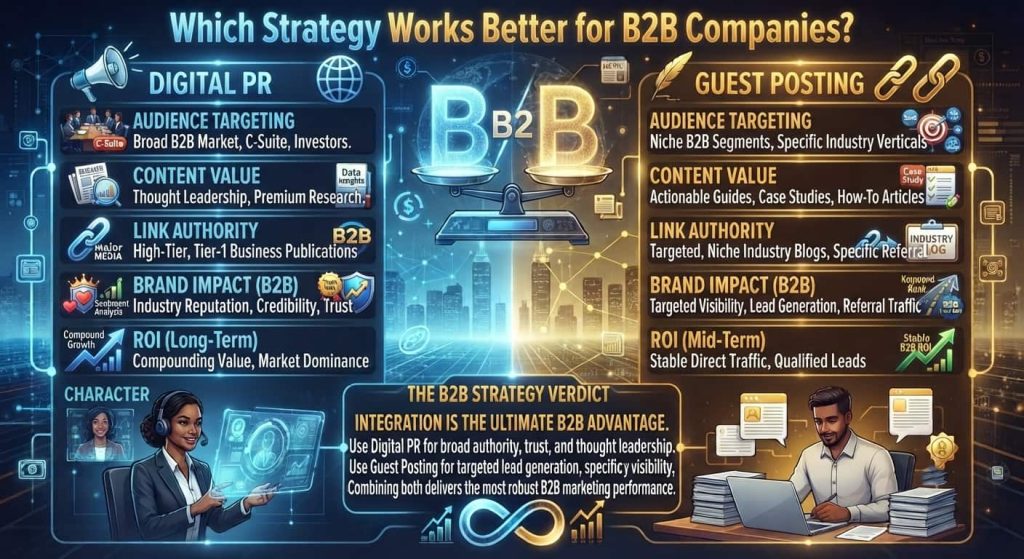
B2B marketing presents a unique challenge because the target audience is often smaller and more specialized. A B2B company may not need millions of visitors. It needs the right visitors.
Digital PR for B2B Authority
Digital PR can position a B2B company as an industry expert. Publishing original research, economic analysis, industry reports, or expert commentary can attract attention from trade publications and business media.
This can be particularly valuable when purchasing decisions involve trust and reputation. A company that repeatedly appears as a source in respected industry publications can gradually establish stronger credibility among potential buyers.
Guest Posting for B2B Lead Generation
Guest Posting can be particularly useful when a company wants to reach a narrowly defined professional audience. For example, an enterprise cybersecurity company could contribute technical articles to specialist cybersecurity publications. The traffic may not be enormous but the readers are highly relevant. This makes Guest Posting a potentially effective combination of SEO and demand generation.
What About Local Businesses?
Local businesses often do not need a large-scale international PR campaign. Their priorities are usually local visibility, reputation, relevant referral traffic, and relationships with organizations within their geographic market.
Digital PR for Local Businesses
Local Digital PR can focus on community stories, local research, events, partnerships, surveys, or data related to the local market. A local real estate company, for example, could publish research about housing trends in its city. A restaurant could analyze local dining trends.
A home services company could publish research about seasonal maintenance problems in the local area. These campaigns can attract attention from local newspapers, magazines, blogs, and community websites.
Guest Posting for Local Businesses
Guest Posting can also work when local companies contribute useful articles to regional or industry-specific publications. A local accounting firm might write about tax planning for small businesses.
A local law firm might contribute educational content about a specific area of law. A home improvement company might publish guides through local property or lifestyle websites. The important factor is relevance. A local backlink from a respected regional website can be more useful than a generic backlink from an unrelated international blog.
Digital PR vs Guest Posting for Enterprise Brands
Enterprise companies typically have larger marketing budgets, stronger internal resources, and access to proprietary data. This creates opportunities for large-scale Digital PR campaigns.
Why Enterprise Brands Can Scale Digital PR
Large companies often have access to customer research, industry data, internal experts, and extensive datasets. These resources can be transformed into reports and research projects that generate significant media attention.
Enterprise companies may also have dedicated PR teams that already maintain relationships with journalists. This makes it easier to distribute campaigns and maximize their potential.
Where Guest Posting Fits Into Enterprise SEO
Guest Posting can still have a role in enterprise SEO, particularly when the company wants to establish expertise within specific industry communities. Instead of publishing generic articles on dozens of websites, an enterprise company can build long-term relationships with a smaller number of respected publications. The emphasis should be on thought leadership rather than link volume.
When Should You Choose Digital PR Over Guest Posting?
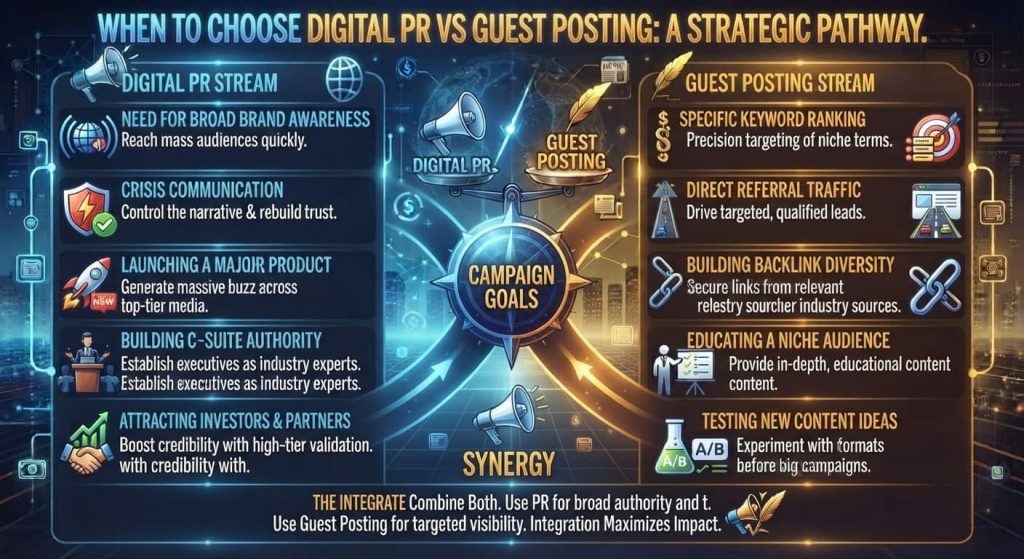
Digital PR is usually the better choice when you have a compelling story, original research, proprietary data, or an idea with genuine news value. It is also attractive when your marketing goals extend beyond SEO.
Choose Digital PR When Brand Awareness Matters
If your company is relatively unknown, media exposure can be extremely valuable. Being mentioned by trusted publications can introduce your brand to audiences that may never discover it through traditional search. This is particularly important for companies operating in competitive markets where trust plays a major role in purchasing decisions.
Choose Digital PR When You Have Original Data
Original data is one of the strongest foundations for Digital PR. Journalists need credible statistics to support their stories. If your company can provide new information rather than repeating statistics that already exist online, your research may become a valuable media resource.
Choose Digital PR When You Want Long-Term Authority
Digital PR can help create an association between your brand and a specific subject. If a company consistently publishes useful research about a particular industry, journalists may eventually recognize it as a reliable source. That can create opportunities for future media coverage.
When Is Guest Posting the Smarter Choice?
Guest Posting is often more appropriate when you need control, niche relevance, and a consistent publishing strategy.
Choose Guest Posting When Your Industry Is Highly Specialized
Some industries do not generate mainstream news. A company selling specialized industrial equipment may not have many opportunities to create viral PR campaigns.
However, specialist publications may actively need expert contributors. Guest Posting can therefore provide a direct route into those communities.
Choose Guest Posting When You Need Consistent Visibility
Digital PR campaigns can be unpredictable. One campaign may perform extremely well while another receives little coverage. Guest Posting offers more predictable publishing opportunities because you can develop relationships with publications over time. This makes it easier to maintain a consistent external content presence.
Choose Guest Posting When You Have Limited PR Resources
Businesses with small marketing teams may find Guest Posting easier to manage. Instead of developing a large research campaign, they can focus on producing a small number of exceptional articles for highly relevant publications. The strategy can then expand as resources become available.
Why Choosing Only One Strategy Can Be a Mistake
The Digital PR versus Guest Posting debate often creates a false choice. Businesses do not necessarily have to select one strategy and abandon the other. In fact, relying entirely on one method can create limitations. A website that only uses Guest Posting may miss opportunities for large-scale brand exposure.
A company that relies entirely on Digital PR may struggle to maintain consistent niche-specific publishing. Combining both allows each strategy to compensate for the weaknesses of the other.
The Power of a Diversified Link Building Strategy
A diversified strategy does not mean randomly collecting different types of backlinks. It means building authority through multiple legitimate channels.
A company might earn media coverage through Digital PR, contribute expert articles through Guest Posting, publish original research on its own website, collaborate with industry organizations, and create resources that naturally attract references. Each activity supports the larger authority-building ecosystem. This is much more sustainable than depending on one repetitive link acquisition tactic.
How to Build a Digital PR and Guest Posting Strategy Together
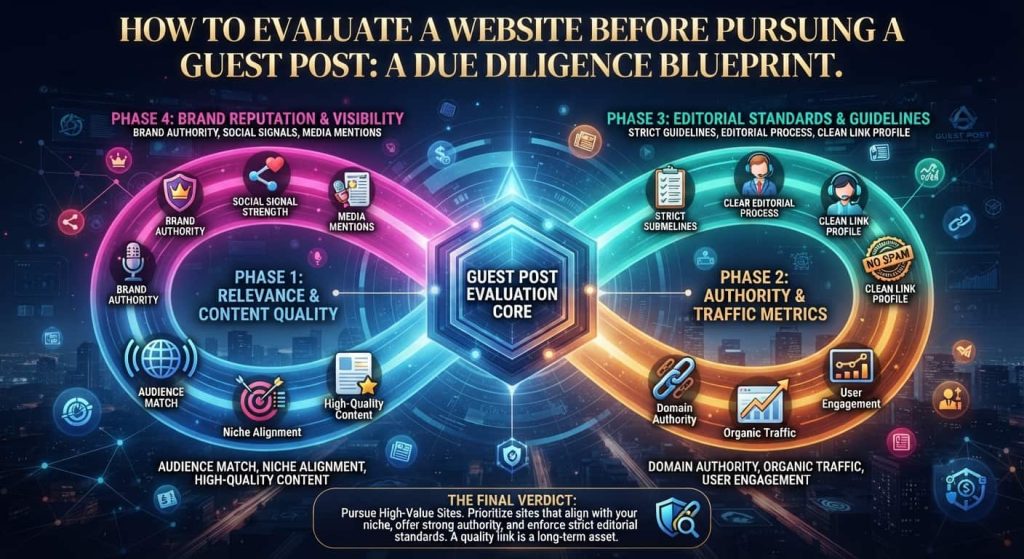
The most effective approach is to give each strategy a specific role. Digital PR can be used for major authority campaigns. Guest Posting can support ongoing industry visibility. Content marketing can provide the assets that both strategies need. Technical SEO and internal linking can ensure that the authority generated externally is efficiently distributed across the website.
Start With Your Core Authority Topics
Before launching outreach, identify the subjects you want your brand to become associated with. These topics should reflect your products, services, expertise, and target audience. For example, a digital marketing company might focus on SEO, content marketing, AI search, technical SEO, and conversion optimization. These topics can then guide both PR campaigns and Guest Posting opportunities.
Create Linkable Assets
Your own website should contain resources worth referencing. These might include original research, comprehensive guides, statistics pages, calculators, templates, studies, tools, or expert reports. Without valuable destination pages, even successful outreach can produce limited long-term value. A backlink is more useful when it points toward a resource that genuinely deserves to be discovered.
Use Digital PR for Major Campaigns
Instead of trying to launch PR campaigns continuously, focus on creating fewer but stronger campaigns. A high-quality quarterly research project can potentially create more value than dozens of weak campaigns. Each campaign should have a clear story, a defined audience, supporting data, and a carefully researched outreach list.
Use Guest Posting for Consistent Industry Presence
Between major PR campaigns, Guest Posting can maintain relationships with relevant publishers. The focus should be on expert content rather than commercial promotion. The more useful the contribution, the more likely it is that the publisher will want to work with the company again.
A Practical Link Building Framework for 2026
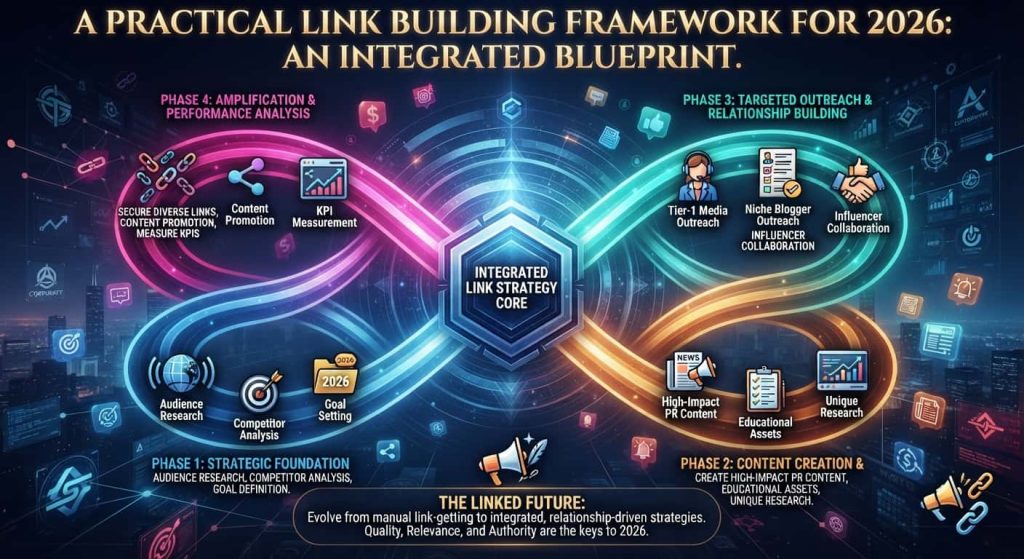
A modern authority-building strategy should not begin with a target number such as “100 backlinks per month.” Instead, it should begin with business goals. A company might set a goal of becoming a recognized authority in a particular industry. The link-building strategy then supports that objective.
Phase One: Build the Foundation
Before launching outreach, make sure the website has strong content, clear information architecture, technical SEO fundamentals, and valuable resources. There is little benefit in generating media attention if visitors arrive on a weak website that does not demonstrate expertise.
Phase Two: Create Authority Assets
Develop resources that people can genuinely reference. Original research is particularly valuable, but comprehensive guides, industry statistics, tools, calculators, and expert reports can also work.
Phase Three: Launch Digital PR Campaigns
Use the strongest assets to develop stories that journalists and publishers may find interesting. Research relevant media contacts rather than sending the same pitch to hundreds of unrelated journalists. Personalization and relevance matter.
Phase Four: Build Publisher Relationships
Guest Posting should not be treated as a one-time transaction. Develop relationships with editors and publishers whose audiences overlap with your target market. Over time, these relationships can create recurring opportunities for expert contributions.
Phase Five: Measure Business Outcomes
Track more than backlinks. Monitor referral traffic, branded searches, organic visibility, conversions, qualified leads, media mentions, and engagement. The purpose of authority building is ultimately to support business growth.
The Most Sustainable Strategy Is Not the One With the Most Links
A successful link-building strategy should become less dependent on aggressive outreach over time. The ideal outcome is that your brand becomes recognizable enough, useful enough, and authoritative enough that other websites begin referencing it naturally.
Digital PR can accelerate this process by creating attention. Guest Posting can support it by building relationships and demonstrating expertise. Content marketing provides the foundation.
SEO connects these activities to organic search visibility. When these elements work together, link building stops being an isolated marketing activity and becomes part of a broader authority-building strategy.
The Link Building Mistakes That Can Undermine Your SEO
Digital PR and Guest Posting can both be valuable, but poor execution can turn an otherwise useful strategy into a source of wasted budget or even SEO risk. The biggest problem is usually not the tactic itself. It is the mindset behind it. When marketers focus exclusively on acquiring as many backlinks as possible, they often sacrifice relevance, quality, editorial standards, and long-term brand value.
Treating Backlinks as a Numbers Game
One of the most common mistakes is setting a monthly backlink target without considering the quality of those links. For example, a business might decide that it needs 50 new backlinks every month. That target can encourage the team to prioritize quantity over relevance.
A better approach is to ask whether the links are helping the website become more visible, credible, and useful within its industry. Ten highly relevant references from respected publications may be more valuable than hundreds of weak placements.
Publishing Guest Posts on Irrelevant Websites
Relevance should always be considered before accepting a publishing opportunity. A website may have impressive traffic or strong third-party SEO metrics, but if its audience has no relationship with your industry, the placement may provide limited value. The ideal publication is one where your content naturally belongs.
If a cybersecurity company contributes an article to a cybersecurity publication, the relationship makes sense. If the same company publishes an article on an unrelated lifestyle blog simply because the site offers a backlink, the strategic value becomes much harder to justify.
Creating PR Campaigns Without a Real Story
Digital PR cannot succeed simply because a company wants media coverage. A campaign needs a reason for journalists and readers to care. Generic promotional announcements rarely have the same potential as original research, unexpected statistics, expert analysis, or genuinely interesting industry findings. The strongest PR campaigns begin with the story rather than the backlink.
How to Evaluate a Website Before Pursuing a Guest Post
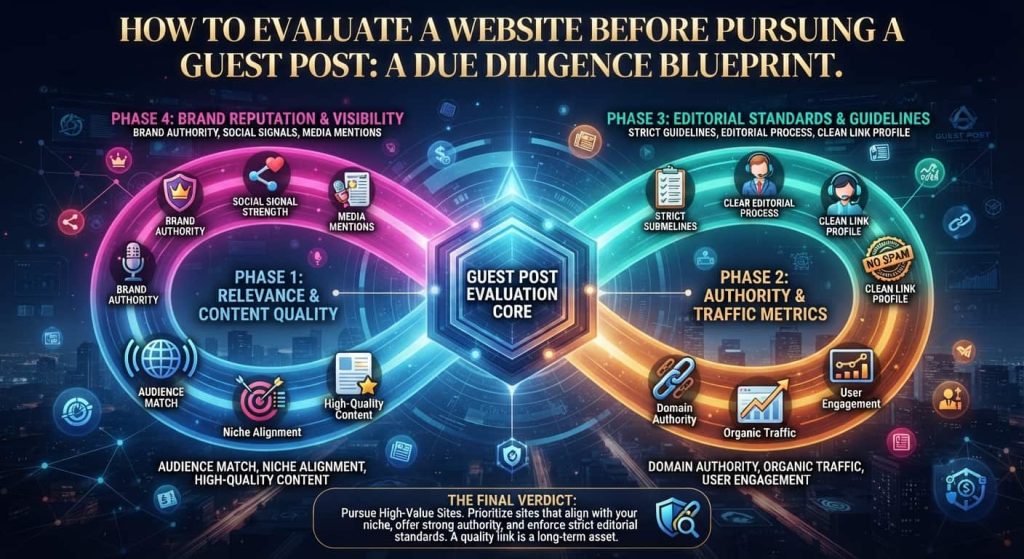
Not every website that accepts Guest Posts is worth targeting. Before investing time in outreach or content production, evaluate whether the publication has genuine editorial and audience value.
Look Beyond Domain Authority
Third-party metrics can be useful for research, but they should never be the only criterion. Look at the website’s actual content, audience, publishing history, topical relevance, organic visibility, and overall reputation. A website with a high SEO metric but thousands of low-quality sponsored articles may be less attractive than a smaller publication with a strong, engaged audience.
The question is not simply whether the website has a high score. The question is whether you would genuinely want your brand associated with that publication.
Check Topical Relevance
A good Guest Posting opportunity should have a logical connection to your business. The closer the relationship between the publication, the article, and your expertise, the more natural the contribution becomes. This also makes it easier to create content that genuinely helps the publication’s readers.
Evaluate Editorial Standards
Look at the quality of recently published articles.
- Are they well researched?
- Are they edited?
- Does the website publish original content?
- Are articles written for readers or primarily for search engines?
- Does the publication clearly identify its authors and contributors?
These signals can help you distinguish a genuine publication from a website that exists primarily to sell placements.
How to Build a Digital PR Campaign That Journalists Actually Want
A successful Digital PR campaign starts long before the first outreach email. The campaign needs a strong concept, credible evidence, a clear story, and an audience that has a reason to care.
Start With an Original Idea
The strongest campaigns usually provide information that is difficult to find elsewhere. Original surveys, proprietary datasets, industry analysis, experiments, and expert research can all become strong PR assets. The more original the information, the easier it becomes to explain why a journalist should reference it.
Turn Data Into a Story
Data alone is rarely enough. A spreadsheet containing thousands of numbers is not automatically newsworthy.
The data needs interpretation.
- What changed?
- Why does it matter?
- Who is affected?
- Is there a surprising finding?
- Can the result be compared with previous years?
These questions turn raw information into a story.
Make the Outreach Relevant
Sending the same pitch to hundreds of journalists is rarely an effective approach. A better strategy is to identify journalists who already cover the subject. The pitch should quickly explain what the research discovered and why it might be relevant to their audience.
Good outreach respects the journalist’s time. It does not require a long explanation before revealing the actual story.
How to Make Guest Posting More Effective
The best Guest Posting strategies look less like link building and more like expert publishing. The objective should be to contribute something that the publication would be happy to publish even if the backlink did not exist.
Write for the Publication’s Audience
Every publication has its own audience, tone, and editorial expectations. An article written for startup founders should not sound identical to an article written for technical SEO specialists.
Before writing, study several recent articles from the publication. Understand what readers expect and identify gaps that your expertise can fill.
Prioritize Expertise Over Promotion
A Guest Post should educate first and promote second. Readers can quickly recognize content that exists primarily to advertise a company.
Instead of repeatedly mentioning your product or service, focus on solving the reader’s problem. A natural reference to a genuinely useful resource is much stronger than an aggressive promotional link.
Build Long-Term Publisher Relationships
The strongest Guest Posting opportunities often come from relationships rather than one-time transactions. If an editor knows that your company consistently produces high-quality expert content, future collaboration becomes easier. This can eventually lead to recurring contributions, expert quotes, interviews, podcast appearances, and other opportunities.
Digital PR vs Guest Posting: A Practical Decision Framework
Choosing between Digital PR and Guest Posting becomes much easier when you start with the business objective. Digital PR should generally be prioritized when the company has something newsworthy to say and wants broad exposure. Guest Posting is often more appropriate when the business wants targeted industry visibility and greater control over content placement.
Choose Digital PR If Your Priority Is Authority and Awareness
Digital PR is particularly suitable for businesses that want to become recognized as an authority. Original research, expert commentary, and proprietary data can create a reason for publishers to discuss the company. The resulting coverage can support SEO while also strengthening brand recognition.
Choose Guest Posting If Your Priority Is Relevance and Consistency
Guest Posting is useful when you want to consistently appear in publications that matter to your industry. It allows you to target specific audiences and develop relationships with publishers over time. For specialized businesses, this can be more practical than attempting to create a newsworthy campaign every month.
Choose Both If You Want a More Complete Strategy
For many established companies, the strongest answer is not either-or. Digital PR can create major bursts of authority and visibility. Guest Posting can provide consistent industry presence between larger campaigns. Together, they create a more diversified approach to external authority building.
A Simple Strategy for Combining Digital PR and Guest Posting
A practical strategy could begin with one or two major Digital PR campaigns each year, supported by ongoing expert contributions to highly relevant publications. The PR campaigns should focus on original research, data, or stories with genuine news value. Guest Posting should focus on educational content, thought leadership, and relationships with trusted industry publications.
At the same time, the company’s own website should continue producing high-quality resources that both strategies can reference.
- This creates a connected system.
- Your website creates valuable assets.
- Digital PR generates attention around those assets.
- Guest Posting expands your presence within relevant communities.
- Internal linking distributes authority across important pages.
- Content marketing provides the foundation.
- SEO connects everything together.
- The result is a strategy designed around authority rather than simply backlink volume.
Digital PR vs Guest Posting: Which One Is Better in 2026?
There is no universal winner. Digital PR is usually stronger when the objective is to generate media attention, brand awareness, editorial coverage, and high-level authority. Guest Posting is often stronger when the objective is to build relationships with relevant publications, reach specific audiences, and maintain consistent external content.
The most effective approach for many businesses is to combine both. Digital PR can create the big moments. Guest Posting can build the ongoing presence. Neither should be treated as a shortcut to rankings. The quality of the content, relevance of the publication, credibility of the source, and usefulness to the audience remain more important than the raw number of links.
Frequently Asked Questions About Digital PR vs Guest Posting
Is Digital PR better than Guest Posting for SEO?
Digital PR can be particularly effective for earning editorial coverage and building brand authority, while Guest Posting provides more control over content and publication opportunities. Neither method is automatically better in every situation. The right choice depends on the business, industry, resources, and marketing objectives.
Is Guest Posting still effective for SEO?
Yes, Guest Posting can still be useful when it involves genuinely valuable content published on relevant, reputable websites. The strategy becomes problematic when articles are produced primarily to manipulate rankings through excessive or low-quality link placement.
Are Digital PR backlinks more valuable than Guest Post backlinks?
Not automatically. The value of a backlink depends on factors such as relevance, credibility, editorial context, and the quality of the referring website. A relevant Guest Post on a respected industry publication can be highly valuable, while an irrelevant media mention may provide less strategic value.
Does Digital PR guarantee backlinks?
No. Digital PR is an earned-media strategy, which means publishers and journalists decide whether they want to cover the story. A strong campaign can generate significant coverage, but there is never a guarantee that every campaign will produce a specific number of backlinks.
How many Guest Posts should a business publish?
There is no universal number. Quality and relevance should determine the publishing frequency. A smaller number of excellent contributions on respected publications is generally preferable to producing large volumes of low-quality articles simply to increase backlink counts.
Can Digital PR and Guest Posting be used together?
Absolutely. In fact, combining the two can create a stronger and more diversified authority-building strategy. Digital PR can generate broad media exposure, while Guest Posting can maintain consistent visibility within specific industries and communities.
What is the biggest mistake in link building?
The biggest mistake is treating link acquisition as a numbers game. A sustainable strategy focuses on earning relevant, credible references that make sense for users and naturally fit within the surrounding content.
Final Verdict: Build a Brand People Want to Reference
Digital PR and Guest Posting are not simply two competing ways to acquire backlinks. They represent two different approaches to building authority online. Digital PR creates stories, research, and information that publishers want to talk about.
Guest Posting creates opportunities for experts and brands to contribute useful knowledge to established audiences. Both can support SEO when they are built around relevance, quality, and genuine value.
If your company has original data, an interesting story, or something genuinely newsworthy, Digital PR may be the best way to generate attention and high-quality editorial coverage. If your priority is targeted industry exposure, consistent publishing, and stronger relationships with relevant publications, Guest Posting can be an effective option. For businesses with sufficient resources, the strongest strategy is often a combination of both. Use Digital PR to create moments that attract attention.
Use Guest Posting to build relationships and demonstrate expertise. Use content marketing to create assets worth referencing. And use SEO to connect these activities into a long-term organic growth strategy. Ultimately, the goal should not be to build the largest backlink profile possible.
The goal is to build a website and brand that publishers, customers, journalists, and industry professionals want to reference. That is the foundation of sustainable authority in modern SEO.