


Google Ads costs in the UK depend on what you advertise, where your customers are and how effectively your campaign turns clicks into business. There is no single price that applies to every advertiser. Your total investment can include advertising spend, campaign management, initial setup and any work needed on landing pages or measurement.
For a useful starting point, separate the money paid to Google from the cost of running the campaign. A £1,000 monthly advertising budget does not necessarily include agency fees, and a low cost per click does not automatically mean affordable customers. The more important question is how much you can spend to generate a qualified enquiry and turn it into profitable work.
This guide explains how Google Ads pricing works, how to plan a small business budget and how to compare management proposals. All worked examples are illustrative planning scenarios, rather than UK market averages, London Design quotations or promised campaign results.
How Much Does Google Ads Cost in the UK?
Your Google Ads cost is determined by the advertising activity your campaign generates and the budget controls you choose. For Search campaigns, cost per click is a useful starting metric: it shows the average advertising spend required to bring someone to your website. However, clicks are only one part of the calculation.
Two businesses spending the same amount can achieve very different outcomes. One may attract relevant visitors who request quotes, while another pays for searches that do not match its services. Differences in targeting, competition, website experience and sales follow-up can all affect the eventual cost of acquiring a customer.
A practical Google Ads budget should therefore answer three questions: how much traffic might your budget buy, how many relevant enquiries could that traffic produce and what proportion of those enquiries could become customers? Without those assumptions, a monthly spending figure provides limited guidance.
Advertising Spend and Management Fees Are Separate Costs
Advertising spend is the money allocated to Google to deliver your campaigns. Management fees pay for the people responsible for planning, monitoring and improving those campaigns. Initial research, account setup, landing page development and tracking configuration may be included in management or charged separately.
When comparing Google Ads agency fees in the UK, request an itemised proposal. It should explain the advertising allowance, management charge, initial work and recurring commitments. Also confirm whether quoted amounts include VAT or any other applicable charges, so you are comparing equivalent totals.
How Does Google Ads Pricing Work?
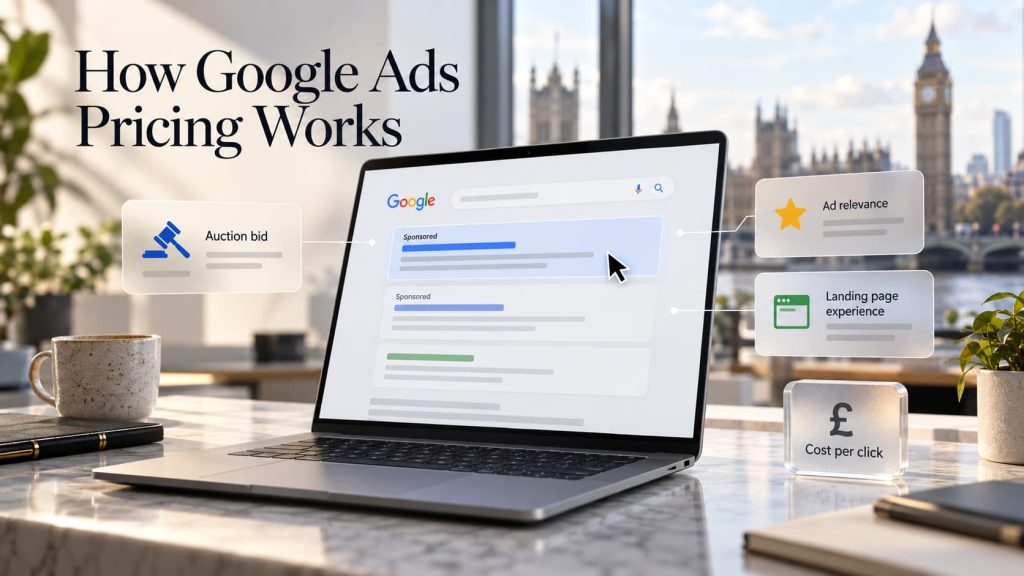
Google Search advertising uses an auction to decide which eligible ads appear and where they are shown. Your bid matters, but it is not the only factor. Google also considers auction-time ad quality, search context, competition, Ad Rank thresholds and the expected impact of ad assets. Paying more does not automatically secure the best placement.
This is why Google Ads pricing should not be treated as a fixed rate card. The same business can face different costs across search terms, locations and campaign conditions. A useful forecast needs to reflect the particular services, audiences and geographic areas you intend to target.
What Is Cost per Click?
Cost per click, usually shortened to CPC, measures what you spend on average for an advertising click. Divide advertising spend by clicks to calculate it. If a campaign spends £600 and receives 200 clicks, its average CPC is £3. That tells you the cost of attracting visitors, but it does not tell you whether those visitors became customers.
A campaign with a £5 average CPC can be more valuable than one averaging £1 if the higher-priced traffic produces more profitable work. Review CPC alongside conversion rate, qualified lead volume and customer acquisition cost rather than using it as the main measure of success.
Why Quality Score Needs Careful Interpretation
Quality Score is a diagnostic tool that helps identify potential weaknesses in expected click-through rate, ad relevance and landing page experience. It can guide investigation, but the displayed score itself is not an input in the ad auction. Improving the underlying experience matters more than chasing a particular score.
For a business owner, the practical priority is consistency. The search term, advert and destination page should describe a relevant offer and make the next step clear. A visitor looking for a specific service should not have to search through unrelated information to find it.
What Should Your Total Google Ads Budget Include?
A realistic PPC budget accounts for the work required to attract visitors, measure their actions and turn suitable enquiries into customers. Some businesses already have a strong website and reliable tracking. Others need preparation before paid traffic can be evaluated properly.
The following breakdown helps identify what belongs in your budget. The exact scope depends on your existing setup, campaign complexity and the services agreed with your provider.
| Cost component | What it covers | What to confirm |
|---|---|---|
| Advertising spend | Campaign delivery through Google Ads | The amount allocated to advertising |
| Initial setup | Research, campaign structure, ads and account configuration | Whether setup is charged separately |
| Ongoing management | Monitoring, optimisation, testing and reporting | Included activities and responsibilities |
| Landing page work | Improving or building campaign destinations | Copy, design, development and testing scope |
| Conversion measurement | Tracking enquiries and relevant business outcomes | Setup, validation and ongoing checks |
| Additional software | Tools such as call tracking or reporting systems | Recurring charges and account ownership |
Allow for Landing Page Preparation
Your landing page should continue the promise made in the advert. A campaign promoting a particular service needs a destination that explains that service, answers likely questions and provides a clear route to enquire. Sending every visitor to a broad homepage can introduce unnecessary steps.
A separate page is not always necessary. An existing service page may already meet the campaign’s needs with a few improvements. Our guide to landing pages vs websites explains how to choose an appropriate destination before committing to additional development.
Include Measurement From the Start
A campaign needs a reliable way to distinguish meaningful enquiries from ordinary website interactions. Successful form submissions, relevant telephone enquiries and confirmed bookings may deserve different treatment from page views or button clicks. Agree which actions represent business value before using them to judge performance.
For longer sales journeys, connecting lead records with later outcomes provides a more useful picture. Google supports enhanced conversions for leads to help attribute imported offline outcomes back to advertising interactions. The appropriate implementation depends on your systems, data handling arrangements and measurement requirements.
How Much Should a Small Business Spend on Google Ads?
The right Google Ads budget for a small business in the UK starts with its commercial goals and expected traffic costs. A tightly focused campaign for one service in one area needs a different plan from a campaign covering several services nationwide. Your ability to respond to enquiries also affects how much demand you should try to generate.
Start with a manageable scope, then estimate the spending needed to investigate it meaningfully. A small budget spread across too many services can make it difficult to understand which parts work. Concentrating on a priority offer can make both spending and results easier to assess.
Use Forecasts Before Choosing a Monthly Figure
Google Keyword Planner can provide estimates of clicks, costs and other potential outcomes for a keyword plan. Forecasts allow you to explore how spending and campaign settings could affect performance. They provide planning evidence, although actual results can differ from the estimates.
Build your forecast around the locations and services you actually intend to advertise. Then compare the likely traffic with a cautious conversion assumption and your acceptable customer acquisition cost. If the numbers do not support the business case, adjust the scope or offer before increasing the budget.
Illustrative Monthly Advertising Budgets
The table below shows how different spending levels translate into clicks under selected CPC assumptions. These are arithmetic examples, not recommended minimum budgets or estimates of what a particular UK industry will pay. Management fees and other costs are excluded.
| Monthly advertising spend | Assumed average CPC | Calculated clicks |
|---|---|---|
| £500 | £2.50 | 200 |
| £1,000 | £5.00 | 200 |
| £1,500 | £5.00 | 300 |
| £3,000 | £10.00 | 300 |
The comparison shows why a budget cannot be judged in isolation. A business facing a higher CPC needs more advertising spend to obtain the same number of clicks. However, those clicks may still be commercially attractive if the service has sufficient margin and the resulting enquiries are suitable.
How Do Daily Budgets and Monthly Spending Limits Work?
For campaigns using an average daily budget, Google can spend different amounts on different days. For most campaigns, the daily spending limit is twice the average daily budget and the monthly spending limit is 30.4 times that budget. This allows delivery to vary with opportunities during the month.
For example, a stable average daily budget of £20 corresponds to a monthly limit of £608 for most campaigns. It does not mean the campaign will spend exactly £20 every day. Budget changes and other campaign arrangements can affect the calculation, so review the account’s budget report when making adjustments.
Plan Across All Active Campaigns
If your account has several campaigns, assess the combined budget rather than reviewing each one separately. A modest allowance for each service, location or promotion can add up to a larger account commitment. Keep a clear record of the total intended advertising spend and how it is distributed.
Remember that an advertising spending limit does not cover every project expense. Management fees, landing page work and external software need their own allowances. Your internal budget should reflect the complete commitment.
How Much Does Google Ads Management Cost in the UK?
Google Ads management costs vary according to the work involved and the provider’s pricing model. A single-service campaign with straightforward tracking can require a different level of support from an ecommerce account with a large catalogue, multiple markets and complex reporting.
Common arrangements include a fixed monthly fee, a percentage of advertising spend and a combination of setup and ongoing charges. A useful comparison looks at deliverables, expertise and accountability alongside the price.
Fixed Monthly Management Fees
A fixed fee makes the management element easier to budget for. Its value depends on the agreed scope: how campaigns are reviewed, what testing is included, how tracking issues are handled and how results are discussed. A lower fee may cover a narrower service, while a higher fee should be supported by a clear explanation of the additional work.
Confirm what happens when the account grows. Adding locations, services or campaign types may change the management requirements. Agreeing how scope changes are handled can prevent uncertainty later.
Percentage-Based Management Fees
Under a percentage-based model, the management charge changes with advertising spend. For an illustrative example, a 15% fee on £2,000 of monthly ad spend would equal £300. That example explains the calculation; it is not a London Design price or a market-wide benchmark.
Check whether the agreement includes a minimum fee and whether setup, creative work or tracking is extra. A percentage alone does not reveal the total cost or the quality of service provided.
Compare the Scope Before Choosing a Provider
A proposal should describe campaign planning, search term reviews, negative keyword management, ad testing, conversion tracking and reporting responsibilities. It should also make account access, payment arrangements and the cancellation process clear.
You can explore London Design’s Google Ads management services to discuss campaign requirements and the support appropriate for your business. Confirm the proposed management charge separately from the advertising budget.
How to Calculate Google Ads Cost per Lead
Cost per lead, or CPL, measures the spending required to generate an enquiry. The advertising-only calculation is advertising spend divided by leads. If you spend £1,000 on ads and receive 25 enquiries, the advertising cost per lead is £40.
For a more complete view, include recurring campaign expenses. If the same month includes £400 in management fees, the combined cost is £1,400 and the blended cost per enquiry is £56. Use consistent definitions when comparing reports so an advertising-only figure is not mistaken for a fully loaded cost.
Qualified Leads Matter More Than Total Enquiries
Not every enquiry is a potential customer. Some may come from outside your service area, concern services you do not provide or fail to meet essential requirements. Reviewing lead quality helps identify whether the campaign is generating commercially relevant demand.
Suppose 15 of the 25 enquiries in the example meet your qualification criteria. The blended cost per qualified lead is approximately £93.33. This gives a different perspective from the £40 advertising-only cost per enquiry and helps explain why headline lead figures need context.
Calculate Customer Acquisition Cost
Customer acquisition cost connects campaign spending with new customers. Continuing the example, if five enquiries become customers, the £1,400 combined monthly cost produces a campaign customer acquisition cost of £280.
Compare that figure with the contribution those customers generate after direct delivery costs. If each customer contributes £600 before marketing and overheads, the five customers contribute £3,000. Subtracting £1,400 leaves £1,600 before overheads and other excluded costs; this is not the same as net profit.
What Is an Acceptable Cost per Lead for Your Business?

An acceptable CPL depends on your margins, sales conversion rate and growth objectives. A lead for a high-value service can justify a different cost from an enquiry about a low-margin purchase. There is no useful universal target without understanding what happens after the lead arrives.
A practical planning formula is: target cost per lead = target customer acquisition cost × lead-to-customer conversion rate. If you are prepared to spend £200 acquiring a customer and 20% of comparable leads become customers, the corresponding target CPL is £40.
Connect Your Target CPL With Click Costs
You can extend the calculation to estimate an affordable CPC. If the target CPL is £40 and 5% of advertising clicks become leads, the corresponding CPC is £2. At £4 per click with the same conversion rate, the advertising cost per lead would rise to £80.
These calculations depend on consistent definitions. If your target acquisition cost includes management and software, reserve an allowance for those expenses before calculating the amount available for advertising. Also use comparable lead types when estimating sales conversion rates.
How Can You Reduce Wasted Google Ads Spend?
Reducing waste starts with identifying where spending fails to support the business. That might involve irrelevant searches, unsuitable locations, unclear messaging or a difficult enquiry process. Increasing the budget before investigating those issues can simply increase the cost of the same problems.
Review campaign data alongside sales feedback. Search reports can show what attracted visitors, while enquiry records reveal whether those visitors were suitable. Both are needed to make sensible optimisation decisions.
Match Targeting to the Services You Actually Sell
Review search terms and identify patterns that do not fit your offer. A company selling a managed service may need to investigate traffic related to jobs, training or unrelated products. Negative keywords can help address unsuitable searches, but exclusions should be chosen carefully to avoid blocking relevant demand.
Location settings also deserve attention. Target the areas you can realistically serve and review where useful enquiries originate. More narrowly worded searches are not automatically cheaper; evaluate them by relevance and outcomes.
Improve the Enquiry Experience
A clear headline, relevant service details, credible evidence and a usable mobile form can help visitors make a decision. Show what happens after an enquiry and provide contact options appropriate for your audience. Test the full journey, including form delivery and confirmation messages.
Where website limitations are affecting campaigns, London Design’s web design services can support a review of the visitor experience. The aim should be to resolve identified barriers rather than assuming every campaign needs a complete website rebuild.
Should You Invest in Google Ads or SEO?
Google Ads can support a focused offer while you actively fund advertising. SEO involves improving organic visibility through your website, content and wider search presence. The appropriate balance depends on your timescale, current visibility, available resources and commercial objectives.
Our SEO vs Google Ads comparison explores how the channels serve different needs. Businesses considering organic growth can also review our search engine optimisation services. Choose the investment mix around a realistic plan for acquiring customers and measuring results.
Frequently Asked Questions About Google Ads Costs in the UK
Is £500 a Month Enough for Google Ads?
A £500 monthly advertising budget may support a focused test, but its usefulness depends on click costs, demand and conversion performance. At an assumed £2.50 CPC it buys 200 clicks; at £10 it buys 50. Confirm whether management fees are additional and whether the resulting traffic can provide useful evidence for your decision.
How Much Does Google Ads Cost per Month for a Small Business?
There is no single monthly amount suitable for every small business. Estimate traffic costs for your target services and locations, then assess the potential enquiries against your commercial targets. Add management, setup and any website or measurement work to understand the total commitment.
Do Google Ads Agency Fees Include Advertising Spend?
They may or may not, depending on how the proposal is presented. Request separate figures for advertising spend, management and additional services. If a package combines them, ask how much is allocated to each component and who is responsible for paying Google.
How Long Should You Test a Campaign Before Judging Results?
Use relevant traffic, conversion volume and your sales cycle to guide the review. A campaign generating enquiries every day provides evidence at a different pace from one selling a specialist service with a long buying process. Investigate clear tracking or targeting problems promptly, while allowing enough time for genuine sales outcomes to emerge.
Does a Higher Google Ads Budget Guarantee More Leads?
No. Additional spend creates room for more advertising activity, but useful demand and conversion performance still matter. Scale with reference to qualified leads, customer acquisition cost and your ability to handle new business. A larger budget should support a stronger business case rather than substitute for one.
Plan a Google Ads Budget Around Your Business Goals
The most useful answer to “How much does Google Ads cost in the UK?” comes from your own services, target market and customer economics. Advertising spend tells you what traffic costs. Lead quality and sales outcomes reveal whether that spending is creating value.
Start with a defined offer, credible forecasts and measurement you can trust. Agree the complete cost of delivery, then review performance against qualified enquiries and acquired customers. This creates a clearer basis for deciding whether to improve, expand or reconsider the campaign.
To discuss the right starting point for your business, book a free Google Ads consultation with London Design. Share your services, target locations and objectives so the conversation can focus on a relevant campaign scope and budget.