


Building a professional website is one of the most important investments a business can make. Yet, when you start researching website design costs in the UK, you quickly discover that prices vary enormously. One web designer might quote £800, while a London agency could propose £15,000 or more for a seemingly similar project.
So, how much does a website cost in the UK in 2026? A simple business website might cost between £500 and £3,000, while a professionally designed small business website typically falls between £2,000 and £8,000. Bespoke corporate websites and advanced e-commerce platforms can cost £10,000 to £50,000 or more, depending on their functionality and complexity.
The difference is not simply about how a website looks. Website design prices depend on the number of unique page layouts, development requirements, content creation, search engine optimisation (SEO), integrations, performance standards and ongoing maintenance.
In this comprehensive guide from London Design, we explain the real cost of building a website in the UK, compare website design pricing across different project types and explore what you should expect to pay before and after launch.
Whether you are launching a start-up, redesigning an existing business website or planning an online store, this guide will help you establish a realistic budget and choose an appropriate web design solution.
Pricing note: All figures are indicative UK market estimates for 2026, rather than official industry averages or guaranteed London Design quotations. Unless otherwise stated, prices exclude VAT, ongoing running costs and separately charged services.
Website Design Costs in the UK: 2026 Price Comparison
The quickest way to understand UK website pricing is to compare different website types, their typical development costs and the functionality they provide.
A basic informational website requires considerably less development than an e-commerce platform with payment processing, customer accounts and inventory integrations. Similarly, a template-based WordPress website generally involves less design and development work than a fully bespoke digital experience.
The following table provides an overview of typical website development costs in the UK in 2026.
| Website type | Typical UK build cost | Estimated timeline | Best suited for |
|---|---|---|---|
| DIY website builder | £0–£500 initially, plus subscriptions | 1–3 weeks | Personal projects and small start-ups |
| One-page website | £300–£1,500 | 1–3 weeks | Freelancers and single-service businesses |
| Small business brochure website | £800–£3,000 | 2–5 weeks | Local businesses and consultants |
| Professional business website | £2,000–£8,000 | 4–8 weeks | Established small businesses |
| Bespoke corporate website | £5,000–£20,000+ | 6–12 weeks | Growing companies and professional brands |
| E-commerce website | £2,000–£15,000+ | 4–12 weeks | Online retailers |
| Advanced e-commerce platform | £15,000–£50,000+ | 3–6 months | Larger online retailers |
| Custom web application | £15,000–£100,000+ | 3–9+ months | Businesses with specialised functionality |
These figures represent broad planning ranges, not a standard price list. Projects at the lower end typically involve fewer templates, limited integrations and existing content. More expensive projects may include dedicated UX research, custom functionality, accessibility work and extensive testing.
For most small and medium-sized UK businesses, a practical starting budget for a professionally designed website is approximately £2,000–£8,000. However, the real question should not simply be how much a website costs. It should be what that website needs to achieve for your business and whether the proposed investment supports those objectives.
How Much Does a Small Business Website Cost in the UK?

A small business website typically costs between £800 and £5,000, depending on its structure, design requirements and who develops it. A straightforward five-page website built using an established theme can cost substantially less than a custom-designed website with dedicated service pages and conversion-focused content.
For many businesses, the website is the first place potential customers interact with the brand. It needs to communicate your services clearly, establish credibility and make contacting your business straightforward.
Professional small business website design should therefore focus on usability, mobile responsiveness, accessibility and opportunities to generate enquiries rather than appearance alone.
What Is Included in a Small Business Website?
A typical small business website contains a homepage, an about page, several service pages and a contact page. Depending on the business, it may also include testimonials, frequently asked questions, a blog or an online booking system.
A well-structured website allows visitors to understand what your business offers without unnecessary navigation. It should provide clear calls to action and work effectively across mobile devices, tablets and desktop computers.
At London Design, our simple website design service focuses on creating professional websites for start-ups, consultants, trades and local businesses that need a credible online presence without complex functionality.
Small Business Website Pricing Breakdown
| Website feature | Typical scope |
|---|---|
| Number of pages | 3–10 |
| Design approach | Template-based or tailored layouts |
| Mobile responsiveness | Usually included |
| Contact forms | Basic enquiries |
| Content management | WordPress or similar CMS |
| Basic on-page SEO | Titles, headings and site structure |
| Analytics | Depends on package |
| E-commerce functionality | Usually excluded |
| Estimated development cost | £800–£5,000 |
| Ongoing costs | Hosting, domain and maintenance |
A website at the lower end of this range may be suitable for a business that simply needs customers to find its contact details and services. A company targeting competitive markets or relying heavily on website enquiries may benefit from a more comprehensive approach.
Before choosing a package, ask whether copywriting, images, hosting, SEO configuration and post-launch support are included. These details can significantly affect the final cost.
How Much Does a Bespoke Website Cost in the UK?
A bespoke website is designed and developed around the specific requirements of a business rather than being assembled entirely from an existing template. In 2026 bespoke website design costs in the UK commonly range from approximately £5,000 to £20,000, although large projects with specialist requirements can exceed this amount.
The higher initial investment reflects the additional work involved in user experience research, information architecture, visual design, front-end development and quality assurance. Unlike a basic website, a bespoke project may require several rounds of wireframing, custom components, content planning and integration with external business systems.
What Makes Bespoke Website Design More Expensive?
The biggest cost difference comes from how much work must be created specifically for your business. A template-based website uses existing layouts and functionality, whereas a bespoke website may require custom interfaces, responsive components and tailored interactions.
For example, a professional services company might need several different landing page templates, lead qualification forms, multilingual functionality and integration with its customer relationship management software Each requirement adds planning, development and testing time. However, that additional investment can provide greater flexibility and a website designed more closely around the customer journey.
If your organisation needs something more sophisticated than a conventional brochure website, explore London’s Design’s bespoke website design services to understand how custom development can support your requirements.
Bespoke Website Cost Breakdown
| Project element | What it typically involves |
|---|---|
| Discovery and strategy | Research, goals and audience planning |
| UX design | User journeys and wireframes |
| UI design | Custom interface and visual components |
| Front-end development | Responsive website implementation |
| CMS development | Content editing and management |
| Technical SEO | Crawlable structure and metadata |
| Integrations | CRM, booking or external systems |
| Testing | Device, browser and functional checks |
| Estimated build cost | £5,000–£20,000+ |
| Typical development period | 6–12 weeks or longer |
A bespoke website is not automatically the right choice for every business. If you only need a few informational pages, a focused and professionally implemented website may deliver better value. However if your website supports lead generation, brand positioning or complex business processes, the flexibility of a tailored solution can justify the investment.
E-commerce Website Cost UK: How Much Does an Online Store Cost?

The cost of an e-commerce website in the UK depends on the number of products, shopping functionality, payment methods, delivery options and required integrations A relatively simple online store built using WooCommerce or Shopify might cost £2,000–£5,000 to set up professionally. A more sophisticated store with custom design, advanced filtering, inventory management and integrations may cost £5,000–£20,000 or considerably more.
Large e-commerce platforms can exceed £50,000 when they require custom development, multiple storefronts, extensive product catalogues or complex operational workflows. Unlike a traditional business website, an online store must support the entire purchasing process, from product discovery through payment and order confirmation.
What Affects E-commerce Website Development Costs?
One of the main factors is the complexity of the product catalogue. A shop selling 20 products with simple delivery options requires less configuration than a retailer managing thousands of products, multiple warehouses and variable shipping rules.
Payment processing, customer accounts, discounts, product filtering, reviews and subscription functionality can also increase development requirements Other important considerations include checkout usability, website performance, mobile shopping experiences, security and integration with existing accounting or stock management software.
A professional e-commerce website should help customers complete purchases efficiently while allowing the business to manage products and orders without unnecessary technical difficulties.
E-commerce Website Pricing Comparison
| Store type | Indicative UK market build cost | Typical requirements |
|---|---|---|
| Starter online shop | £2,000–£5,000 | Small catalogue, basic checkout |
| Small business e-commerce | £3,000–£8,000 | Product categories and payment integration |
| Growing online retailer | £5,000–£15,000 | Tailored design and enhanced functionality |
| Advanced online store | £15,000–£30,000 | Integrations and custom workflows |
| Enterprise e-commerce | £30,000–£50,000+ | Multi-store or complex infrastructure |
These are broad UK market ranges. Individual agency packages may sit below or above them depending on precisely what is included.
London Design E-commerce Website Packages
London Design publishes two e-commerce website packages, providing businesses with a more specific starting point when planning their investment.
| Package | Published starting price | Selected features |
|---|---|---|
| Starter E-commerce | £1,499 | Custom design, categories, checkout, payment gateway integration, basic SEO and 30 days of support |
| Professional E-commerce | £3,499 | Advanced UX/UI, product filtering, customer accounts, multiple payment integrations and 90 days of support |
These are the advertised package prices, not a guarantee that every store can be delivered for those amounts. Final scope, exclusions, VAT treatment and recurring costs should be confirmed in a written proposal.
You can review the complete packages and their features on the London Design e-commerce website design page.
Shopify vs WooCommerce: Which Is More Cost-Effective?
Both Shopify and WooCommerce are widely used for building online stores, but their pricing models differ Shopify operates as a hosted subscription platform. Merchants pay ongoing platform charges and may incur additional costs for themes, applications, payment processing and custom development.
WooCommerce is an open-source e-commerce system built on WordPress. The software itself is free to use, but businesses must pay for hosting, development, security, maintenance and any commercial extensions they require.
| Cost consideration | Shopify | WooCommerce |
|---|---|---|
| Platform model | Hosted subscription | Open-source WordPress plugin |
| Hosting | Included in platform | Purchased separately |
| Initial setup | Often simpler | Depends on configuration |
| Design customisation | Themes and custom development | Themes and extensive custom development |
| Extensions | Paid or free apps | Paid or free plugins |
| Maintenance | Core platform managed by Shopify | Store owner or provider manages updates |
| Payment fees | Depend on plan and provider | Depend on gateway and provider |
| Long-term flexibility | Within Shopify ecosystem | Greater control over hosting and code |
For smaller businesses prioritising straightforward management, Shopify can be attractive. WooCommerce may be more suitable for organisations seeking greater control over their content, technical architecture or hosting arrangements.
Neither platform is automatically cheaper over the long term. A meaningful comparison should include development, subscriptions, integrations, payment fees and maintenance over at least three years.
DIY Website Builder vs Freelancer vs Web Design Agency: Which Costs Less?
One of the biggest decisions when planning website development is choosing who will build it You can develop a website yourself using an online website builder, hire an independent web designer or work with a professional web design agency. Each option has different costs, responsibilities and potential limitations.
The right choice depends on your available budget, technical requirements, internal resources and how important the website is to your business.
Building a Website Yourself
DIY website builders such as Wix and Squarespace offer templates and editing tools that allow non-technical users to create websites For small projects, subscription costs may be relatively modest. However, creating suitable content, configuring pages, selecting images and testing the site all require time.
DIY platforms can be suitable for early-stage projects, but limitations may emerge when businesses require specialised functionality, advanced integrations or greater control over their website.
Hiring a Freelance Web Designer
Freelancers can provide a cost-effective solution for businesses that need professional assistance without the overheads associated with a larger agency A freelance web designer in the UK may charge anywhere from several hundred pounds to several thousand pounds, depending on their experience and the project’s complexity.
The main consideration is whether one person can cover the complete project, including design, development, technical SEO, copywriting and future support.
Working With a Web Design Agency
A web design agency can bring together designers, developers, strategists and digital marketing specialists This approach is particularly valuable when a website must support business growth, attract organic search traffic or integrate with other digital systems.
An agency-led project usually requires a greater investment than a basic freelance build, but it may provide more comprehensive planning, testing and accountability.
Website Development Provider Comparison
| Factor | DIY builder | Freelancer | Web design agency |
|---|---|---|---|
| Initial investment | Low | Low to medium | Medium to high |
| Design flexibility | Template-dependent | Varies by expertise | Usually broader |
| Custom development | Limited or platform-dependent | Depends on individual | Team-based capability |
| SEO expertise | Self-managed | Varies | May be included or offered separately |
| Project management | Self-managed | Direct communication | Structured delivery |
| Ongoing support | Platform or self-managed | Depends on agreement | Often available |
| Best suited for | Simple projects | Small to medium sites | Growth-focused and complex projects |
If your website plays a significant role in generating revenue or enquiries, the cheapest initial quote may not represent the lowest total cost A useful comparison should consider the quality of the proposed solution, the level of support and the flexibility to expand the website as your business grows.
What Determines Website Design Prices in the UK?

Two websites with the same number of pages can have very different development costs. A five-page website with standard layouts and supplied text is not comparable to a five-page website requiring original design, custom illustrations, a booking integration and professionally written content Understanding the major cost factors helps businesses evaluate quotations more accurately.
Number of Pages and Unique Layouts
Page count affects development cost, but the number of unique templates often matters more. For example, ten service pages sharing the same layout may be relatively straightforward to implement. Five pages with completely different interactive designs may require significantly more development.
This is why a professional quote should distinguish between reusable page templates and individually designed pages.
Custom Design and User Experience
Custom design requires research, planning and testing. Designers may create wireframes, visual mock-ups and responsive layouts before development begins Additional work is often needed to improve navigation, accessibility, readability and conversion paths.
These activities can increase upfront costs but help prevent usability problems that become expensive to correct after launch.
Website Functionality and Integrations
Features such as online booking, customer accounts, quote calculators, payment systems and multilingual content can increase development time Integrating a website with existing CRM, accounting, email marketing or inventory systems introduces further technical requirements The cost depends on whether reliable existing integrations are available or custom functionality must be developed.
Content Creation and Copywriting
Website copy is an important part of communicating your business proposition. Some web design packages assume the client will provide all text and images. Others include copywriting, photography, content migration and search-focused page optimisation. If your business needs professionally written service pages, additional content should be included in the budget from the beginning.
Search Engine Optimisation
A search-friendly website requires logical information architecture, accessible navigation, appropriate metadata, fast loading times and indexable content.
However, SEO-ready website development is not the same as an ongoing SEO campaign Keyword research, competitor analysis, content production, technical audits and link acquisition may require additional services.
Businesses planning to attract customers from Google should consider professional SEO services during the initial website planning process rather than treating SEO as an afterthought For a broader understanding of ongoing optimisation budgets, read our SEO pricing guide for 2026.
What Are the Hidden Costs of Building a Website?
The quoted website development fee is only one part of the overall investment. After launch, businesses may need to pay for domain registration, hosting, professional email, software licences, technical support, security and marketing These costs are sometimes included in a managed package, while other providers charge for them separately.
Domain Registration
Your domain name is the address customers use to access your website A standard domain may cost approximately £10–£30 per year, although prices depend on the extension, registrar and renewal terms. Premium domain names can cost considerably more. Make sure the domain is registered in an account controlled by your business, with renewal notifications and access details properly documented.
Website Hosting
Hosting is the infrastructure that makes your website available online Basic shared hosting can be relatively inexpensive, while managed WordPress hosting, cloud servers and high-traffic infrastructure cost more.
For many small business websites, planning approximately £60–£600 per year provides a broad starting allowance, depending on the hosting service and performance requirements.
Website Maintenance and Security
Websites require ongoing attention to remain functional and secure Maintenance may include content management system updates, security patches, backups, monitoring and compatibility checks A managed website maintenance arrangement can range from a modest monthly fee to several hundred pounds, depending on the level of service.
Premium Plugins and Software
Businesses using WordPress, WooCommerce or other platforms may need commercial extensions for booking systems, advanced forms, multilingual content or specific integrations Some licences are charged annually, while others operate on monthly subscriptions.
Before choosing a platform, confirm which features depend on third-party subscriptions and how much those subscriptions will cost to renew.
Typical Website Running Costs in the UK
| Ongoing expense | Indicative annual cost |
|---|---|
| Domain registration | £10–£30 |
| Website hosting | £60–£600 |
| Basic maintenance and updates | £300–£1,200 |
| Premium themes and plugins | £0–£300+ |
| Business email | £60–£180 per mailbox |
| SSL certificate | Often included with hosting |
| Additional content updates | Depends on requirements |
| SEO and digital marketing | Quoted separately |
These costs should not automatically be added together without checking your provider’s package. A managed website plan may already include hosting, SSL, backups and maintenance.
The important point is to establish the total recurring cost and confirm which services are essential, optional or included.
How Much Does a Website Cost Over Three Years?
Comparing initial development prices can be misleading because websites continue to incur costs after publication A better way to evaluate different proposals is to calculate the total cost of website ownership over three years.
This approach combines initial design and development with hosting, maintenance and recurring software expenses For example, a website costing £2,500 to build with £600 in annual operating costs would cost approximately £4,300 over three years, excluding VAT and additional marketing.
Example Three-Year Website Budget
| Website scenario | Initial build | Annual running cost | Estimated three-year total |
|---|---|---|---|
| DIY business website | £0 | £300 | £900 |
| Basic freelancer website | £1,500 | £400 | £2,700 |
| Professional small business website | £4,000 | £900 | £6,700 |
| Bespoke business website | £9,000 | £1,500 | £13,500 |
| Growing e-commerce website | £12,000 | £2,500 | £19,500 |
These are illustrative budgeting scenarios, not surveyed market averages or quotations. They assume one initial build and three complete years of the stated running costs. VAT, transaction fees, paid advertising, major redesigns and additional development are excluded.
A three-year calculation also reveals an important difference between ownership and subscription-based website arrangements Some services offer a low initial fee but require an ongoing contract. Others charge more upfront while allowing the business greater control over hosting, code and future development Before signing an agreement, check what happens if you decide to change provider.
Does VAT Affect Website Design Costs in the UK?
VAT can make a significant difference to the final price of a website development project The standard UK VAT rate is 20%, and VAT-registered suppliers generally charge VAT on standard-rated UK web design services where applicable. For example, a £5,000 website development quote excluding VAT would total £6,000 if 20% VAT is added.
| Website quote excluding VAT | VAT at 20% | Total including VAT |
|---|---|---|
| £1,000 | £200 | £1,200 |
| £2,500 | £500 | £3,000 |
| £5,000 | £1,000 | £6,000 |
| £10,000 | £2,000 | £12,000 |
| £20,000 | £4,000 | £24,000 |
Whether your business can recover VAT depends on its VAT status and the relevant tax rules When reviewing proposals, establish whether quoted prices include VAT and whether additional services will be invoiced separately.
For tax treatment specific to your circumstances, seek guidance from a qualified accountant or tax adviser.
Website Redesign Cost UK: Is It Cheaper Than Building a New Website?
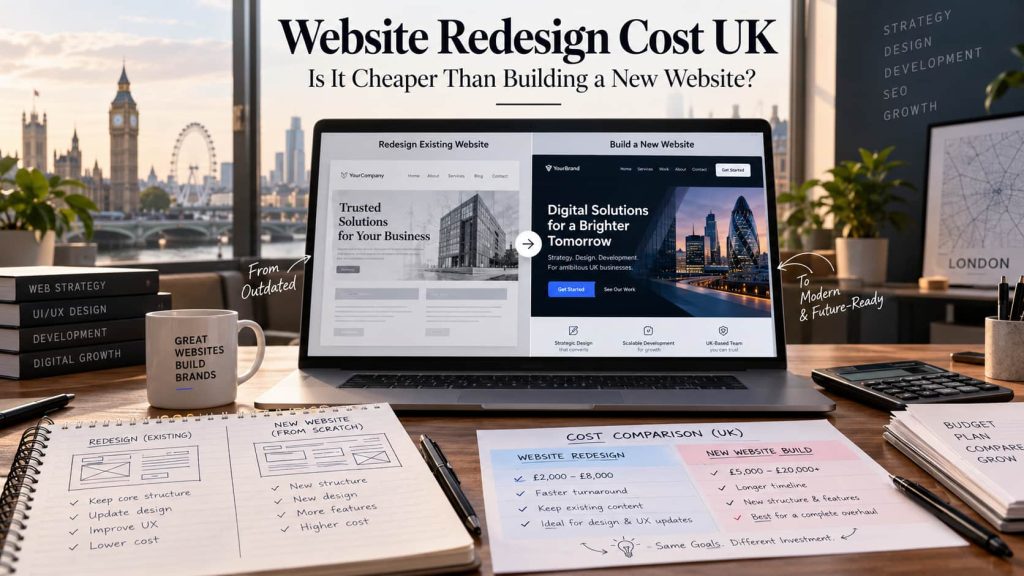
Redesigning an existing website can sometimes cost less than developing a completely new one, but this depends on the condition of the existing system If the website has a stable content management system, reusable templates and suitable functionality, the project may focus primarily on visual improvements and content restructuring.
However, if the existing website is difficult to maintain, performs poorly or relies on outdated technology, a more substantial rebuild may be necessary Website redesign projects can also introduce additional work involving content migration, redirect planning and SEO preservation.
What Should a Website Redesign Include?
A successful redesign should begin with an assessment of the current website’s strengths and weaknesses This involves reviewing existing pages, organic search performance, user behaviour, conversion opportunities and technical limitations The development team can then identify which elements should be retained, improved or replaced.
If your website already receives traffic from Google, protecting existing search visibility is particularly important Before making structural changes, read our website redesign SEO checklist to understand how URL changes, redirects, internal linking and technical validation should be handled.
When Is a Complete Rebuild Worth the Investment?
A complete rebuild may be appropriate when the existing website is no longer capable of supporting your business requirements Examples include difficult content management, poor mobile usability, recurring performance problems or extensive dependence on obsolete software The decision should be based on a technical and commercial assessment rather than assuming that a visually outdated website must always be rebuilt from scratch.
How Much Should You Budget for a Website in London?
Website design prices in London can be higher than those offered by some regional providers, particularly for projects requiring senior specialists, extensive research or dedicated project management.
However, location alone is not a reliable measure of quality or value. An experienced regional agency may charge more than a small London studio, and a London-based agency may offer competitively priced packages for straightforward websites A business should compare the work proposed rather than assuming that similar project descriptions mean identical services.
London Website Design Prices by Project Scope
| Project scope | Indicative planning budget |
|---|---|
| Basic brochure website | £1,000–£3,000 |
| Professional small business website | £3,000–£8,000 |
| Bespoke marketing website | £5,000–£15,000 |
| Larger corporate website | £10,000–£30,000+ |
| Advanced digital platform | £20,000–£50,000+ |
These ranges are intended to help with initial planning. They are not fixed London Design prices, and London projects can fall outside them When comparing web design agencies in London, request a clear explanation of the proposed deliverables, development approach, timescales and ongoing responsibilities.
At London Design’s web design agency in Mayfair, projects are approached around business goals, user experience, mobile performance and search-friendly website architecture.
How to Compare Website Design Quotes Without Overpaying
Choosing a website designer based entirely on the lowest quoted price can create difficulties later Two proposals may appear similar while including very different levels of design work, SEO preparation, testing and support A transparent quotation should define the project’s scope and explain how additional requirements will be handled.
Questions to Ask Before Hiring a Website Designer
Before accepting a website design proposal, establish who will own the domain, hosting account, website content and relevant design assets You should also clarify whether the website can be transferred to another provider, whether editing access will be supplied and what happens when maintenance or support arrangements end. Other important questions concern content responsibilities, mobile testing, performance requirements, accessibility, SEO deliverables and post-launch support.
Website Design Quotation Checklist
| Item to confirm | Why it matters |
|---|---|
| Number of pages and templates | Defines the development scope |
| Design process and revisions | Prevents misunderstandings |
| CMS and editing access | Supports future content management |
| Domain and hosting ownership | Avoids unnecessary dependency |
| Mobile responsiveness | Supports visitors across devices |
| SEO configuration | Provides a search-friendly foundation |
| Copywriting and imagery | Clarifies content responsibilities |
| Integrations | Identifies technical requirements |
| Testing and quality assurance | Helps prevent launch problems |
| Maintenance and updates | Defines recurring responsibilities |
| VAT and payment terms | Clarifies final costs |
| Change requests | Controls scope and additional fees |
A well-defined proposal does more than explain the price. It reduces uncertainty, establishes accountability and helps both parties understand what a successful project will deliver.
How to Reduce Website Development Costs Without Sacrificing Quality
Reducing website development costs does not necessarily mean choosing a cheaper provider In many cases, the most effective approach is to define a focused first version of your website and avoid unnecessary functionality.
A company launching a new service may not need a complex customer portal immediately. A well-designed website with clear service pages and effective enquiry forms could be sufficient for the first phase Additional features can then be introduced when there is a clear business requirement.
Start With the Most Important Pages
Prioritise pages that help visitors understand your services, evaluate your credibility and contact your business For a typical service company, these often include the homepage, main service pages, about page and contact page If your business plans to invest in SEO, establish a logical structure for future content so the website can grow without expensive restructuring.
Prepare Your Content Before Development
Having approved copy, brand assets and suitable images ready before development begins can reduce delays and revision cycles It also allows designers to create layouts around real content instead of temporary placeholder text Content preparation is particularly important for businesses with multiple services, specialist terminology or regulatory requirements.
Use Existing Technology Where Appropriate
Not every project requires a completely custom content management system Established platforms such as WordPress, WooCommerce and Shopify can provide useful foundations for many business websites. Using proven tools where they meet your requirements can reduce development time and make future maintenance easier.
Plan for Future Growth
A low initial price can become expensive if a website cannot support additional pages, integrations or traffic later. Choose a solution that suits your current requirements while allowing reasonable expansion A structured approach to website planning can help businesses avoid paying for unnecessary complexity today or expensive redevelopment tomorrow.
Is Professional Website Design Worth the Cost?
A professional website should be evaluated as a business asset, not simply a visual product Its value depends on how effectively it helps your organisation achieve its objectives, whether those involve generating enquiries, making online sales, supporting customers or communicating your brand.
For a service-based company, a website that consistently produces qualified leads can become an important customer acquisition channel. For an online retailer, improvements to product navigation and checkout usability can affect the shopping experience and commercial performance However, investing in a more expensive website does not automatically produce better results. A successful project also depends on the offer, content, traffic acquisition and ongoing optimisation.
Measuring Website Return on Investment
To assess commercial performance, businesses can examine the number of enquiries, conversion rate, average customer value and acquisition costs.
Consider a hypothetical business that spends £5,000 on a website. If its website helps generate five additional customers with £500 in contribution profit each, those customers would contribute £2,500 before accounting for further costs.
This example illustrates why a website’s effectiveness matters more than its initial price alone. It is not a revenue forecast or guarantee Website analytics, conversion tracking and a clear understanding of customer acquisition can help businesses evaluate whether the investment is delivering meaningful value.
Why SEO Should Be Considered Before Launch
A website can be visually impressive without attracting meaningful organic traffic Search visibility requires a combination of relevant content, crawlable architecture, technical quality and a strategy aligned with user search intent.
Building these foundations during website development is generally more efficient than correcting preventable problems after launch For businesses planning long-term organic growth, London Design provides search engine optimisation services alongside website design and development.
Choosing the Right Website for Your Business in 2026
There is no universal website package that suits every business.
A start-up with a limited budget may benefit from a simple website that communicates its offer effectively. An established professional services company may require a bespoke website with dedicated landing pages and stronger brand differentiation.
An e-commerce business needs a different approach, particularly if online transactions, product management and integrations form a central part of its operations The following comparison summarises suitable starting points for common business requirements.
| Business requirement | Recommended approach | Indicative budget |
|---|---|---|
| Establish an online presence | Simple brochure website | £800–£3,000 |
| Generate local service enquiries | Professional business website | £2,000–£6,000 |
| Build a differentiated digital brand | Bespoke website | £5,000–£15,000+ |
| Sell products online | E-commerce website | £2,000–£15,000+ |
| Support complex digital operations | Custom development | £15,000+ |
| Improve an outdated website | Website redesign | Scope-dependent |
The most appropriate option is the one that meets your actual requirements and can be supported financially after launch A useful website proposal should therefore explain not only what will be built, but also how the website will be managed, maintained and improved over time.
Get a Website Design Quote From London Design
Understanding average website design prices in the UK provides a useful starting point, but the cost of your own project will depend on its specific requirements At London Design, we work with businesses seeking professional websites that combine clear design, practical functionality and a strong foundation for digital growth.
Whether you need a straightforward business website, a bespoke digital experience or an online store, the first step is understanding your goals, audience and required functionality You can explore our web design services in London, review the available e-commerce website packages or contact London Design to discuss your project A discovery conversation can help clarify your requirements, identify an appropriate development approach and establish a realistic budget before work begins.
Frequently Asked Questions About Website Costs in the UK
How much does a basic website cost in the UK in 2026?
A basic website in the UK may cost approximately £300–£1,500 for a simple one-page or template-based project. A professionally built small business website with several pages typically costs more, depending on content, design and functionality.
What is the average cost of a small business website in the UK?
Many small business website projects fall within the £2,000–£8,000 range when delivered professionally. However, there is no single reliable market-wide average. Prices differ according to scope, supplier and included services.
How much does a five-page website cost in the UK?
A relatively straightforward five-page website may cost between £800 and £3,000. Custom design, professional copywriting, integrations or more extensive SEO work can increase the final price.
How much does a WordPress website cost?
A professionally developed WordPress website can cost from approximately £800 for a simple template-based build to £10,000 or more for a bespoke business website. Hosting, commercial plugins and maintenance may involve additional costs.
How much does an e-commerce website cost in the UK?
A small professional online store may cost around £2,000–£5,000, while more advanced e-commerce projects can reach £15,000–£50,000 or more. London Design also advertises specific e-commerce packages starting from £1,499, subject to their stated scope.
How much does it cost to maintain a website per month?
A small business may pay approximately £20–£150 per month for hosting and maintenance, depending on the services included. Larger websites, advanced applications and high-traffic stores can cost more.
Is it cheaper to build a website yourself?
A DIY website builder typically has a lower upfront monetary cost, but you must spend time creating content, configuring functionality and maintaining the site. Whether it provides better value depends on your skills and business needs.
Why are web design agencies more expensive than freelancers?
Agencies may provide a broader range of expertise, including strategy, design, development, SEO and project management. Their costs reflect the team and delivery process involved, although pricing varies considerably between providers.
Do website design prices include SEO?
Some website packages include basic SEO foundations such as metadata, responsive layouts and search-friendly page structures. Comprehensive keyword research, content strategy and ongoing SEO services are often priced separately.
How much does a bespoke website cost in London?
A bespoke business website in London may cost approximately £5,000–£20,000 or more. Large corporate websites and specialised platforms can require substantially greater budgets.
How long does it take to build a professional website?
A simple website may be completed in a few weeks, while a professional business website often takes four to eight weeks. Bespoke and e-commerce developments may require several months depending on complexity and content readiness.
Can I get a professional website for £1,000?
Yes, some freelancers and small providers offer basic websites around this price. The scope is likely to be limited, so confirm the number of pages, functionality, content responsibilities and ongoing costs.
Should I pay monthly or upfront for website design?
Both models can work. An upfront project fee may offer greater cost clarity, while a monthly arrangement can spread expenditure. Always compare the total contract cost, ownership conditions and cancellation terms before deciding.
Is a £5,000 website worth it for a small business?
It can be, particularly when the website supports customer acquisition or important business processes. Value depends on the quality of the solution, its commercial purpose and the results it helps generate, rather than the price alone.
Does website design cost include VAT?
Not necessarily. Many UK suppliers publish prices excluding VAT. Where standard-rated services are subject to 20% VAT, a £5,000 quote would total £6,000 including VAT.
What is the cheapest way to build a professional business website?
For a business with limited requirements, a focused website using an established platform and a small number of essential pages may offer the best balance between cost and quality. Avoid paying for functionality that does not currently support your business goals.