

Search is no longer limited to a list of blue links.
People are increasingly asking complex questions directly to AI powered search engines and expecting a complete answer instead of a list of websites to visit. Tools and search experiences powered by generative AI can understand questions, combine information from multiple sources and present a conversational response that may include citations, brands, products and recommendations.
This change has created a new area of digital marketing known as Generative Engine Optimization or GEO.
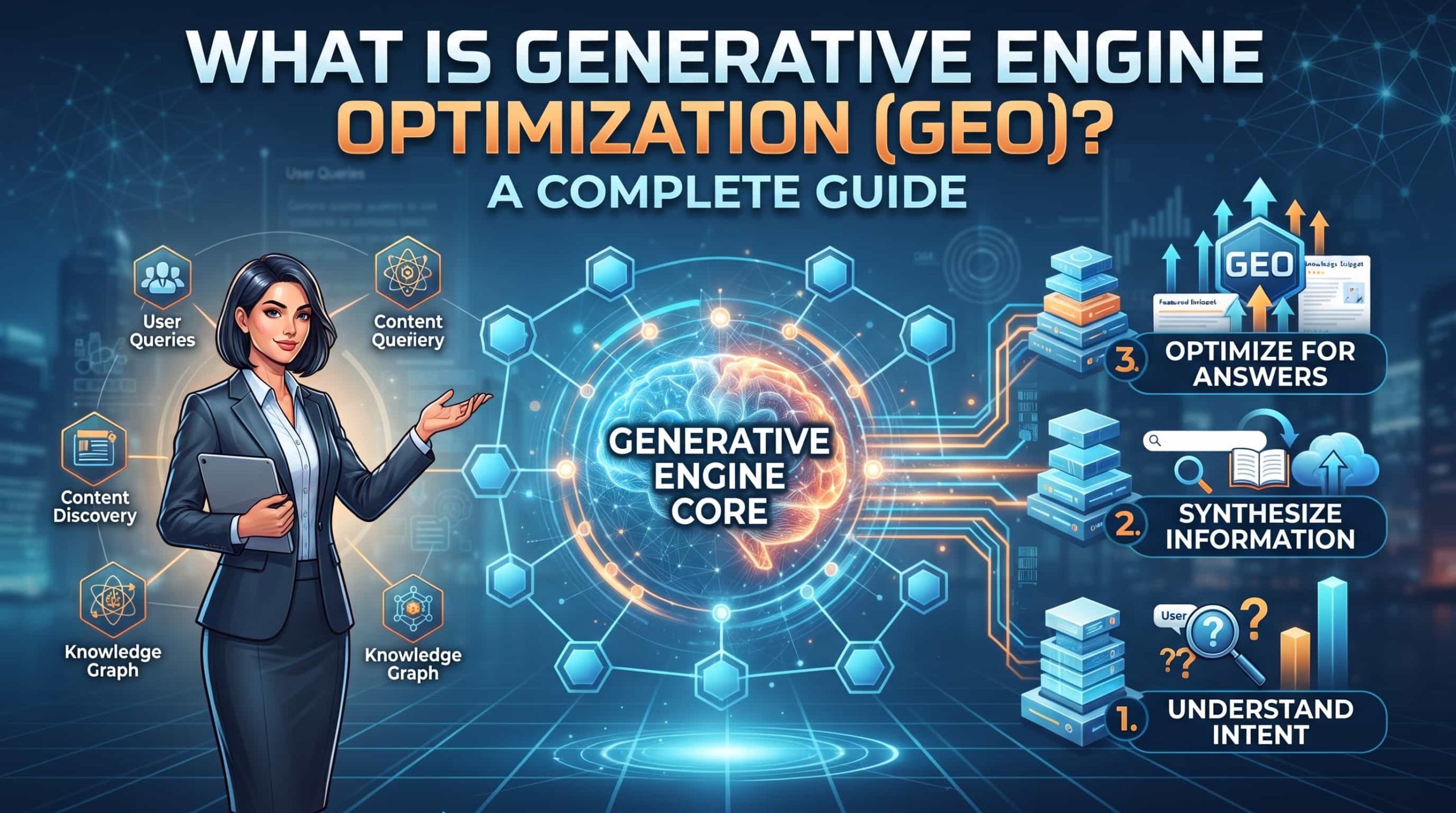
Generative Engine Optimization (GEO) is the practice of making your website, content and brand information easier for generative AI systems to discover, understand and potentially reference when answering user questions. It does not mean abandoning traditional SEO or trying to manipulate AI systems with a secret formula. Instead, effective GEO builds on many of the same principles that have always made websites valuable, including useful and relevant content, technical accessibility, topical relevance, authority and trust. Understanding these fundamentals is also important when evaluating broader SEO strategies, including factors discussed in guides such as How Much Does SEO Cost in 2026. Ultimately, strong GEO and traditional SEO share the same foundation: creating reliable, accessible and genuinely useful information that serves both users and modern search systems.
The difference is where visibility happens.
Traditional SEO is primarily concerned with helping a webpage appear in search results. GEO also considers what happens when an AI system reads information from multiple sources and generates an answer for the user.
This guide explains what Generative Engine Optimization is, how it works, how it differs from SEO, why E-E-A-T matters, how to create content that works well in AI search and what businesses should be doing now to build visibility in an increasingly AI driven search environment.
Search Has Changed and Your Content Strategy Needs to Change With It
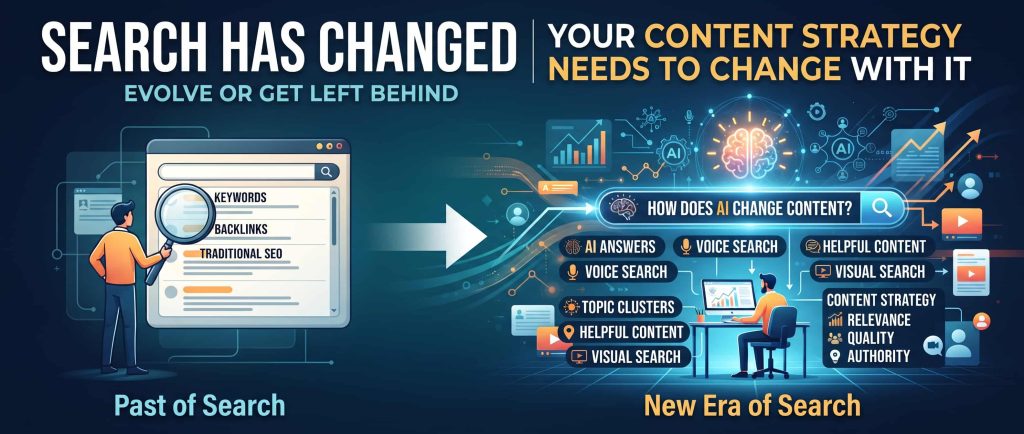
For a long time, the basic search journey was relatively predictable. A user entered a query into Google, reviewed the search results and clicked on one or more pages to find the information they needed. SEO strategies were built around improving rankings, increasing organic traffic and earning clicks from relevant search queries.
Generative search introduces another layer to this process. Instead of simply showing users a collection of pages, an AI powered search experience can interpret the question, retrieve information from different sources and generate a synthesized response.
That means a user may discover your company without clicking your website first.
Your brand could be mentioned in an AI generated answer, your content could be used as a source, or your product could appear as part of a comparison created by an AI system. In these situations the traditional concept of ranking still matters, but it is no longer the only way to think about search visibility.
This is one of the reasons GEO has become an important topic for marketers, SEO professionals and businesses. The goal is not simply to rank for more keywords. The goal is to build an online presence that search engines and AI systems can understand as relevant, useful and trustworthy.
What Is Generative Engine Optimization and What Does GEO Actually Mean?
Generative Engine Optimization is the process of improving a website’s content, information architecture, brand signals and online presence so generative AI systems can more easily understand and potentially use that information when generating answers.
The term GEO is often used broadly because there is no single generative engine with one universal ranking algorithm. Different systems can use different models, retrieval methods, data sources and quality signals.
The practical idea is much simpler.
When someone asks an AI search engine a question related to your industry, you want your brand and content to be among the information sources that the system can discover, understand and consider relevant.
Imagine someone asks an AI search engine
“Which digital marketing agency is experienced with technical SEO for ecommerce websites?”
A traditional SEO strategy might focus on ranking a service page for “technical SEO agency”. A GEO strategy would also consider the broader information ecosystem around that topic.
- Does the website clearly explain technical SEO?
- Does it demonstrate experience with ecommerce?
- Are the services clearly defined?
- Are there useful case studies?
- Does the company have a recognizable entity across the web?
- Are its claims supported by evidence?
- Can an AI system easily understand what the company does and who it serves?
This is where GEO becomes more than keyword optimization.
Why Are Businesses Suddenly Paying Attention to AI Search?
The growing importance of AI search is connected to a fundamental change in how people consume information.
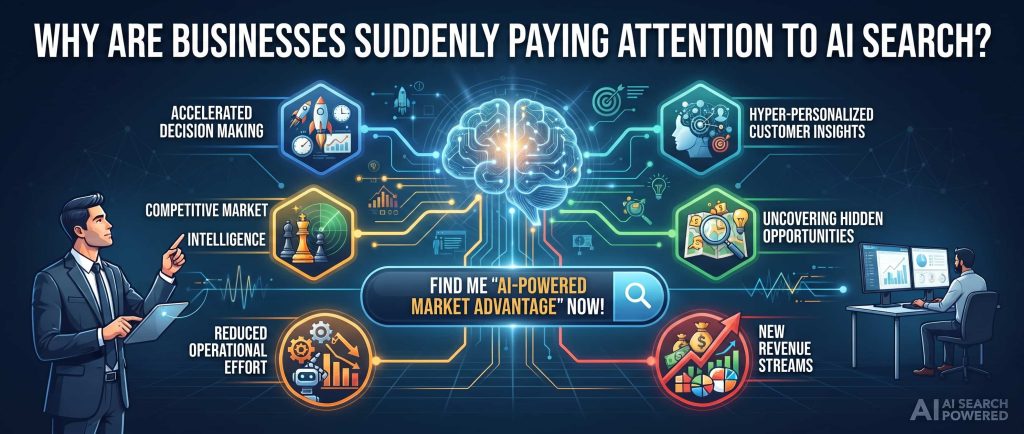
Users are increasingly comfortable asking long and conversational questions instead of breaking their research into several short searches. They may ask for comparisons, recommendations, explanations and multi step research in a single prompt.
For example a traditional search might be
“best CRM for small business”
A conversational search could be
“I run a small B2B company with five salespeople and a limited budget. What CRM should I consider and what features should I prioritize?”
The second question contains significantly more context. An AI system can use that context to construct an answer based on multiple concepts such as company size, budget, sales process, CRM features and business requirements.
This means content strategies need to move beyond isolated keywords and consider the questions, entities, relationships and decision making processes surrounding a topic.
Google’s documentation for AI features in Search also emphasizes that existing SEO fundamentals continue to matter for AI search experiences. In other words, GEO should be viewed as an evolution of search optimization rather than a completely separate discipline.
GEO vs SEO: Are They Really Two Different Strategies?
GEO and SEO are closely connected.
SEO helps search engines discover, crawl, understand and rank webpages. GEO extends the conversation into generative search environments where information may be retrieved and synthesized into an answer.
A useful way to think about the difference is that SEO traditionally asks
“How can this page become more visible for relevant searches?”
GEO asks an additional question
“How can this information become useful to an AI system that needs to answer a related question?”
The overlap is substantial.
Technical accessibility still matters. Relevant content still matters. Search intent still matters. Internal linking still matters. Authority still matters. Trust still matters.
The main difference is that GEO places more emphasis on information clarity, entities, context, semantic relationships, source quality and the ability of content to provide useful evidence for a generated response.
This is why businesses should be careful with claims that GEO has replaced SEO.
It has not.
A stronger strategy is to build an SEO foundation and then optimize the broader information ecosystem around the brand and its content.
The Real Goal of GEO Is Not to “Rank in ChatGPT”
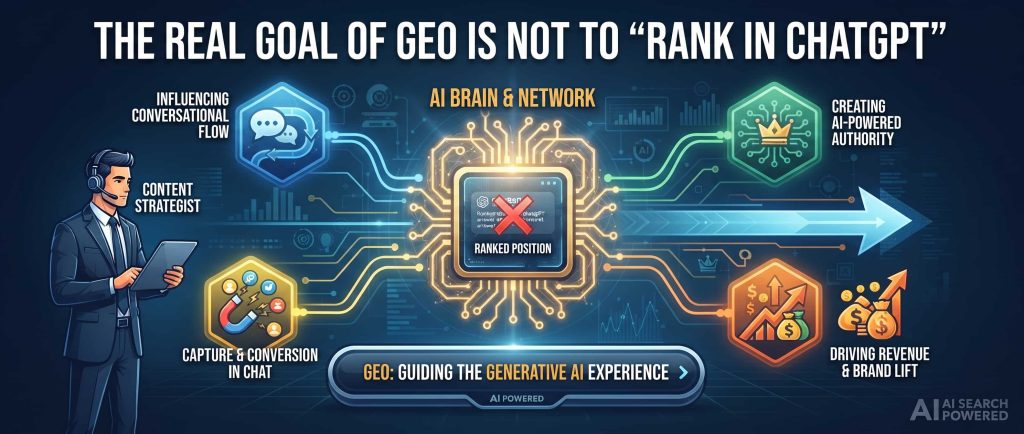
One of the biggest misconceptions about GEO is that businesses can optimize a page specifically to guarantee that an AI tool will mention them.
There is no universal GEO ranking formula and there is no reliable technique that guarantees a brand will appear in every AI generated answer.
Generative systems can change their retrieval sources, models, ranking systems and responses. The same question can also produce different answers depending on context, location, freshness and other factors. This makes simplistic GEO tactics unreliable.
The better approach is to create information that genuinely deserves to be discovered and referenced. When a company provides original research, detailed service information, authentic customer experiences, credible authorship, useful guides and consistent information across reputable sources, it gives both search engines and AI systems more meaningful information to understand and use. This is particularly important as businesses explore new forms of search visibility and questions such as How to Rank in ChatGPT Search Results become increasingly relevant. Rather than trying to manipulate AI systems, brands should focus on building a reliable and authoritative information ecosystem that makes their expertise clear and useful across different search experiences.
The objective is therefore not to “hack the AI”.
The objective is to become a useful and trustworthy information source within your topic.
How Does Generative Engine Optimization Work Behind the Scenes?
Although different AI search systems work differently, many generative search experiences involve some combination of query understanding, information retrieval, source evaluation and response generation.
When a user submits a question, the system first needs to understand what the person is actually asking. A complex query may contain several concepts and relationships that need to be interpreted before relevant information can be retrieved.
The system can then retrieve potentially relevant information from available sources. Depending on the platform, those sources may include webpages, structured information, databases, documents or other forms of knowledge.
The retrieved information can then be evaluated and used to construct a response.
This is important for GEO because your content is not necessarily competing only for a traditional ranking position. It may be competing to become part of the information set from which an answer is constructed.
That makes clarity extremely important.
If a page clearly explains what a product does, who it is for, what makes it different and how it compares with alternatives, an AI system has more usable information to interpret.
If the same information is hidden behind vague marketing language, excessive jargon or poorly structured content, the system has less clear evidence to work with.
Why Semantic SEO Has Become More Important in the GEO Era
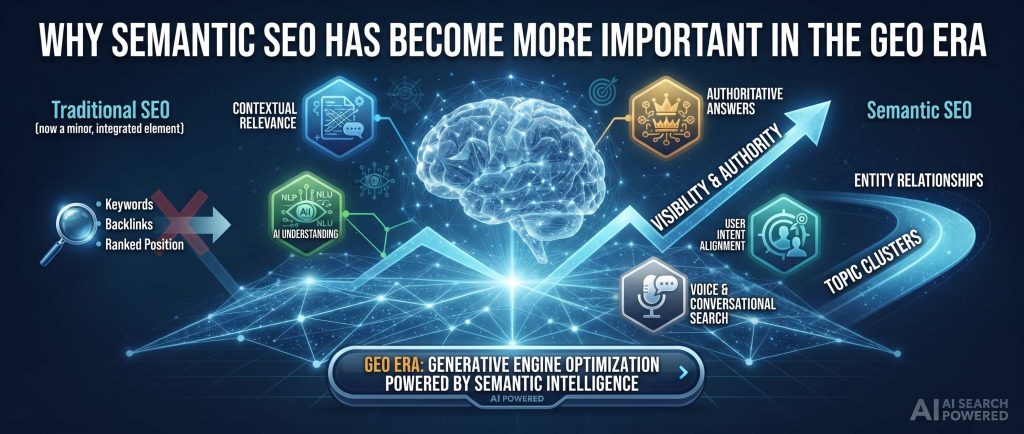
Keywords are still useful, but modern search is not based on keywords alone.
Search engines and AI systems increasingly need to understand relationships between concepts.
Consider the topic “technical SEO”.
A strong semantic content ecosystem might naturally include concepts such as crawling, indexing, canonicalization, robots.txt, XML sitemaps, JavaScript rendering, Core Web Vitals, structured data, redirects, internal linking and log file analysis.
These concepts are not simply keywords to insert into an article.
They are related entities and subtopics that help define what technical SEO actually means.
This is where semantic SEO and GEO overlap.
When a website consistently covers the important concepts surrounding a subject, it becomes easier for search systems to understand its topical focus.
The same principle applies to brands.
If a company consistently publishes useful information around a particular subject and its website, authors, services and external references reinforce the same context, the overall entity becomes easier to understand.
E-E-A-T Is One of the Strongest Foundations for GEO
E-E-A-T stands for Experience, Expertise, Authoritativeness and Trustworthiness. Although E-E-A-T is not a simple ranking score that you can increase from 60 to 90, the principles behind it are extremely useful when building content for modern search. Generative search makes this even more important because AI systems need reliable information when constructing answers.
Experience Gives Your Content Something Generic AI Content Cannot
Experience is demonstrated through real involvement with the subject. Imagine two articles about ecommerce SEO.
The first article simply explains that ecommerce websites should optimize category pages, product pages and internal links.
The second article explains common problems discovered during real ecommerce audits such as faceted navigation creating thousands of crawlable URLs, category pages competing with product pages and filters generating duplicate URL combinations. The second article provides more than definitions. It provides practical knowledge.
Experience can also appear through case studies, original screenshots, implementation examples, testing results, first hand observations and detailed explanations of problems that professionals actually encounter.
Expertise Makes Content More Than a Collection of Definitions
Expertise is about demonstrating genuine knowledge.
A GEO focused article should not simply mention important terminology. It should explain how concepts work together and where common assumptions are wrong.
For example, saying that “backlinks improve SEO” is a broad statement.
A more useful explanation would discuss relevance, authority, link context, editorial placement and the difference between earning meaningful references and acquiring links purely for manipulation.
That depth makes the content more useful to people and gives AI systems more meaningful information to interpret.
Authority Develops Across the Entire Website and Web
Authority is not created by one article.
It develops through consistent topical coverage, strong content, recognizable authorship, relevant mentions, quality references and a reputation that exists beyond a single webpage.
This means GEO should not be treated as an on page optimization project only.
Your website is one part of a larger digital ecosystem. Brand mentions, expert contributions, industry publications, reputable directories, interviews, research citations and other relevant references can all contribute to how an entity is understood online.
Trust Is the Part You Cannot Fake for Long
Trust becomes especially important when content can influence business decisions, financial choices, health-related decisions or other high-consequence topics. A trustworthy website should clearly identify who is responsible for its content, provide accurate and up-to-date information, support important claims with reliable evidence and avoid making statements that cannot be verified. This becomes particularly relevant for businesses investing in strategies such as SEO Marketing for Small Business, where building credibility and demonstrating genuine expertise can have a direct impact on how users and search systems perceive the brand. Ultimately, trust is not just about making content look professional; it is about consistently providing information that people can understand, verify and confidently rely on.
It should also keep important business information consistent. Company names, services, product information, authorship and other important details should not contradict each other across major sources. For GEO, this consistency can make the broader entity easier to understand.
What Makes Content More Likely to Be Useful in AI Generated Answers?
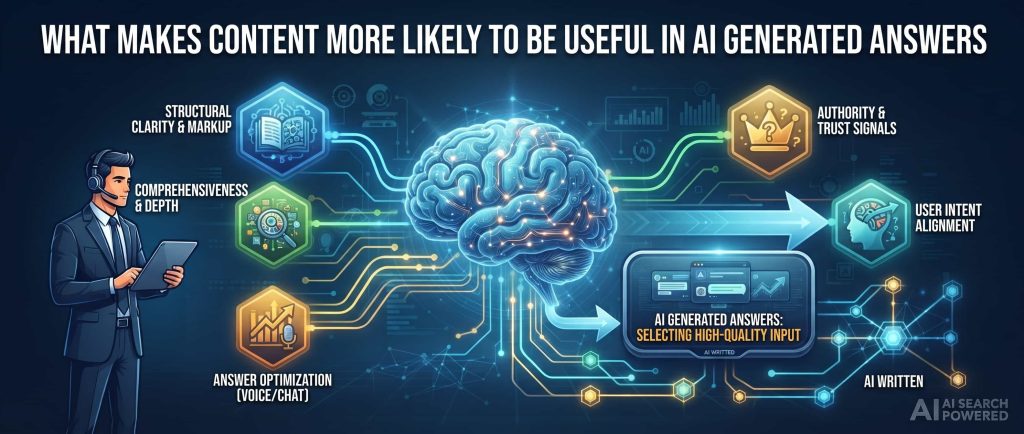
There is no guaranteed formula for becoming a cited source in generative search.
However, certain content characteristics consistently make information easier to understand and use.
The first is directness.
If an article takes 800 words to answer a question that could be explained clearly in the first few paragraphs, the reader may leave before reaching the useful section.
The second is depth.
Directness does not mean making content shallow. The best content can provide a concise answer first and then explain the reasoning, examples, limitations and practical implications.
The third is evidence.
Original data, expert commentary, examples, case studies and references can make an article substantially more useful than generic summaries.
The fourth is structure.
Clear headings, descriptive subheadings, logical sections and meaningful internal links help both users and search systems understand how information is organized.
Original Research Can Give Your Brand a Major Content Advantage
One of the most powerful ways to strengthen GEO is to publish information that does not exist everywhere else. Think about the difference between rewriting ten existing articles about SEO and publishing an original study based on thousands of search queries or website audits.
The first approach adds another summary to the internet. The second creates a potential source that other websites may reference.
Original research can include industry surveys, customer data, testing results, anonymized case studies, benchmark reports, experiments and proprietary datasets. This type of content can create natural citations and mentions because other writers have a reason to reference it. That is valuable for traditional SEO and potentially valuable for generative search as well.
How to Optimize an Existing Website for GEO
A practical GEO strategy usually starts with the existing website rather than creating hundreds of new AI focused pages. Start by identifying the topics that matter commercially.
These should connect your products or services with the problems your target audience is trying to solve. Then examine whether the website clearly demonstrates expertise around those topics.
A service page that only says “We provide professional SEO services” provides very little contextual information. A stronger page might explain the types of SEO work offered, the industries served, the methodology, typical problems addressed, reporting process, experience and examples of outcomes. This gives users more information and creates a stronger semantic context around the service.
Build Topic Clusters Instead of Publishing Random Articles
A website becomes much stronger when related content supports a central topic. Suppose a company provides technical SEO services.
Instead of publishing unrelated marketing articles, it could build a content cluster around technical SEO. The main service page could be supported by detailed resources covering crawling, indexing, JavaScript SEO, canonical tags, XML sitemaps, structured data, site migrations and Core Web Vitals.
These pages can then connect through contextual internal links. The result is a clearer topical ecosystem.
Users can move from general explanations to specific problems and eventually to commercial pages. Search engines also receive stronger contextual signals about the site’s expertise. This is far more sustainable than publishing large quantities of disconnected articles simply because keyword tools show search volume.
Write for Questions People Actually Ask
One of the easiest ways to improve GEO readiness is to analyze conversational search intent.
People rarely think in keywords when they have a real problem.
They think in questions.
Instead of only targeting
“GEO SEO”
you might need content addressing questions such as
- “What is Generative Engine Optimization?”
- “How does GEO work?”
- “Is GEO different from SEO?”
- “How do I optimize content for AI search?”
- “How can my brand appear in AI generated answers?”
- “Does traditional SEO still matter for AI search?”
- “What makes AI systems cite a website?”
These questions can become sections within a comprehensive guide or separate supporting resources depending on the depth of the topic. The important thing is not to create a page for every minor variation. The important thing is to understand the underlying search intent and satisfy it completely.
Make Your Content Easy for Humans and Machines to Understand
Good GEO content should not sound like it was written for a machine.
In fact, the opposite is often more useful.
Use clear language.
Explain specialized terminology when necessary.
Keep paragraphs focused.
Use descriptive headings.
Answer questions directly.
Support important claims.
Avoid unnecessary repetition.
Give readers examples that connect abstract concepts to real situations.
Structured content does not mean robotic content.
A well organized article can still have a natural writing style, strong opinions where appropriate and a clear human voice.
The goal is to remove ambiguity rather than remove personality.
Internal Linking Can Strengthen Your GEO Strategy
Internal linking is often discussed as a traditional SEO tactic, but it also contributes to the contextual structure of a website. Imagine a website has a main guide about Generative Engine Optimization. That guide links to detailed resources about semantic SEO, E-E-A-T, topical authority, AI search, technical SEO and content strategy.
Each supporting page then links back to relevant sections of the main guide. This creates a network of related information. The links provide context about how the topics relate to one another and help users navigate deeper into the subject.
Internal links should therefore be created because they make sense for the reader, not because every page needs a specific number of links.
Structured Data and Machine Readability Still Matter
Structured data can help search engines understand specific information about a webpage.
Depending on the page type, this may include information about articles, products, organizations, events, breadcrumbs and other entities.
Structured data should accurately represent visible content and should not be used to create information that does not exist on the page.
GEO does not mean adding every possible schema type to every page.
The goal is to make legitimate information easier for machines to interpret while maintaining a technically sound website.
This is another example of how traditional technical SEO and GEO work together rather than competing with each other.
Brand Entity Optimization Is Becoming More Important
A brand is more than a domain name.
Search engines need to understand what the organization is, what it does, which products or services it provides and how it relates to other entities.
This is why consistent brand information matters.
Your website should clearly identify the organization.
Author pages should provide meaningful information when appropriate.
Important business details should remain consistent across reputable platforms.
Relevant external mentions should reinforce rather than contradict the brand’s identity.
Over time this creates a stronger digital entity.
For GEO, entity clarity matters because AI systems need context when deciding whether two pieces of information refer to the same organization, product or person.
Common GEO Mistakes That Can Damage Your Strategy
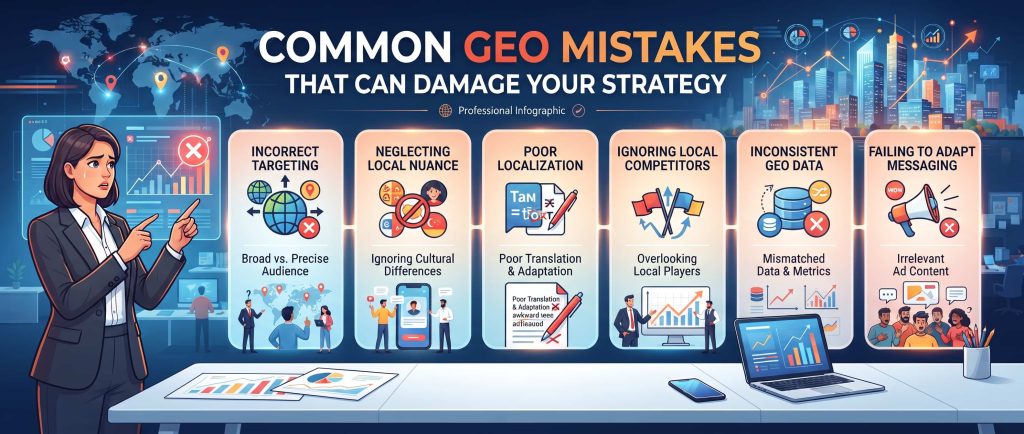
One of the biggest mistakes is treating GEO like a keyword stuffing exercise. Repeating phrases such as “AI search optimization” dozens of times does not make content more useful.
Another common mistake is mass producing AI generated articles with little original value. The internet already contains enormous amounts of generic content. Publishing another slightly rewritten version rarely creates a meaningful competitive advantage. A third mistake is focusing exclusively on AI platforms while ignoring technical SEO.
If search engines cannot reliably crawl or understand your website, adding conversational phrases to articles will not solve the underlying problem. Another mistake is measuring GEO only through traditional rankings. A brand can receive increased visibility through mentions, citations, referral traffic, branded searches and assisted conversions without seeing an immediate change in a single keyword position.
How Should You Measure GEO Performance?
GEO measurement is still evolving. There is no universal equivalent of Google Search Console that provides a complete GEO visibility score across every AI system.
However, businesses can monitor several useful signals. One is brand mentions within AI search results. Another is whether important commercial pages or informational resources are being referenced when users ask questions related to the business.
Referral traffic from AI platforms can also provide useful evidence when analytics systems identify the source. Branded search growth, direct traffic, assisted conversions and mentions across third party websites can provide additional context. The most useful approach is to combine these signals rather than relying on a single GEO metric.
Does GEO Mean Traditional SEO Is Dead?
No.
The idea that GEO replaces SEO is one of the least useful ways to think about the future of search.
AI search still depends heavily on information that can be discovered, interpreted and evaluated.
Technical SEO therefore remains important.
Crawlability matters.
Indexability matters.
Site architecture matters.
Page experience matters.
Content quality matters.
Internal linking matters.
Authority matters.
The difference is that the search environment is becoming more diverse.
A modern SEO strategy needs to consider traditional search results, AI generated answers, conversational search, branded discovery and other emerging search interfaces.
SEO is becoming broader rather than disappearing.
What Does a Strong GEO Strategy Look Like in Practice?
A practical GEO strategy begins with understanding the business.
- What does the company sell?
- Who does it serve?
- What problems does it solve?
- Which topics influence purchasing decisions?
- Which questions do customers ask before becoming customers?
Once those questions are clear, the next step is building a strong topical ecosystem around them.
The website should contain useful commercial pages supported by genuinely helpful informational content.
Those pages should be connected through logical internal links.
Authors and expertise should be clear. Important claims should be supported where appropriate. Technical SEO should make the information accessible.
External references and brand mentions should reinforce the company’s identity and expertise. This creates a system where SEO, content strategy, brand building and GEO work together rather than operating as separate marketing projects.
The Future of GEO Will Be Less About Tricks and More About Information Quality
As generative search becomes more sophisticated, temporary optimization tricks are likely to become less useful. The long term advantage will come from owning valuable information.
Brands that conduct original research, document real experience, answer difficult customer questions and develop genuine topical authority have something meaningful to contribute to the information ecosystem.
That is fundamentally different from creating content simply because an AI tool can produce it cheaply. AI can help businesses research, organize and improve content production. But publishing large amounts of automatically generated text is not the same as building authority.
The strongest GEO strategy is therefore not about producing more content. It is about producing better information.
A Practical GEO Checklist for Your Website
Before considering a website ready for generative search, review the fundamentals.
- Does the website clearly explain what the company does and who it serves?
- Does every important commercial topic have a useful landing page?
- Does the site demonstrate genuine experience and expertise?
- Are authors and content ownership clear where relevant?
- Does informational content answer real customer questions?
- Are important claims supported by credible sources or first hand evidence?
- Are related pages connected through contextual internal links?
- Is the website technically accessible to search engines?
- Is structured data implemented accurately where appropriate?
- Does the brand have consistent information across important external sources?
- Does the website publish original insights rather than only rewriting existing information?
- Can a reader understand the answer quickly and then explore the subject in greater depth?
If the answer to these questions is yes, the website is already following many of the principles that make a strong foundation for GEO.
Final Thoughts: GEO Is the Next Layer of Search Visibility
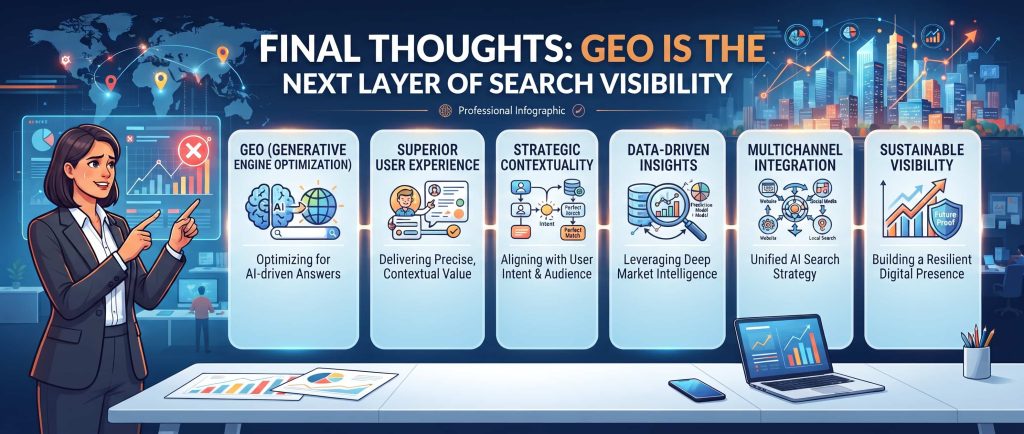
Generative Engine Optimization is not a magic formula for getting your brand mentioned by AI systems. It is a broader approach to digital visibility that focuses on making information easy for search engines, AI systems and users to discover, understand, verify and use. The rise of AI-powered search is changing the way people find and consume information, but it does not eliminate the fundamentals of good SEO. Technical accessibility, high-quality content, topical relevance, authority, trust and a strong user experience still provide the foundation for long-term visibility. What has changed is the environment in which this information is discovered and consumed.
Instead of competing only for a position on a traditional search results page, brands increasingly need to become useful and trustworthy sources within conversational search experiences. This means that simply publishing keyword-optimized articles is no longer enough to build strong visibility. Businesses need to demonstrate genuine expertise, create original and useful information, develop topical authority and make their brand and its areas of expertise clear to both users and search systems. The goal is not to manipulate AI platforms into mentioning a brand, but to create information that is valuable enough to be considered when an AI system needs to provide a reliable answer.
Businesses that approach GEO from this perspective are not simply optimizing their websites for today’s AI search platforms. They are building a stronger digital information ecosystem that can adapt as search continues to evolve. When a website consistently provides accurate information, demonstrates real expertise, answers meaningful questions and supports its claims with trustworthy sources and original insights, it becomes more useful across multiple search environments. In the long term, GEO is less about finding a shortcut to AI visibility and more about building the kind of digital presence that search engines, AI systems and users can understand, trust and rely on.
Frequently Asked Questions About Generative Engine Optimization
What is Generative Engine Optimization?
Generative Engine Optimization or GEO is the process of improving a website’s content, structure, authority and brand information so generative AI systems can more easily discover, understand and potentially reference that information when generating answers.
Is GEO the same as SEO?
No. GEO and SEO overlap significantly but focus on different aspects of search visibility. SEO primarily focuses on improving visibility in traditional search results while GEO also considers how information can be retrieved and used within AI generated answers. Strong GEO generally builds on strong SEO fundamentals.
How can I optimize my website for AI search?
Start with the fundamentals. Create useful content that directly answers real user questions, demonstrate experience and expertise, build topical authority, maintain strong technical SEO, use logical internal linking and keep important brand information clear and consistent across the web.
Does AI generated content help with GEO?
Using AI to assist with research, outlining or editing can be useful, but simply producing large quantities of generic AI generated content does not create a strong GEO strategy. Content still needs to provide genuine value, demonstrate expertise and satisfy the user’s intent.
Does E-E-A-T matter for GEO?
E-E-A-T is highly relevant as a framework for creating trustworthy content. Demonstrating experience, expertise, authority and trust can make a website more credible to users and provide stronger signals about the quality and reliability of its information.
Can GEO guarantee that my brand will appear in AI answers?
No. There is no universal GEO technique that guarantees inclusion in AI generated answers. Different AI systems use different technologies and information sources, and generated responses can change over time.
Should I stop doing SEO and focus only on GEO?
No. Traditional SEO remains an important foundation for modern search visibility. Technical SEO, crawlability, indexability, content quality, internal linking and authority continue to matter as search experiences become more AI driven.
What is the most important part of a GEO strategy?
The most sustainable approach is to create genuinely useful and trustworthy information around the topics that matter to your audience and business. Original research, practical experience, strong topical coverage and clear brand information can create a stronger foundation than short term optimization tactics.
Conclusion
Generative Engine Optimization represents an important evolution in how businesses think about organic visibility.
The future of search is not simply about ranking a webpage for a keyword. It is increasingly about whether your brand and information can be understood and trusted across different search experiences.
The businesses that adapt successfully will not necessarily be the ones that publish the most content. They will be the ones that provide the clearest answers, demonstrate genuine expertise, build recognizable authority and create information that people and search systems can actually use. That is the real opportunity behind GEO.