

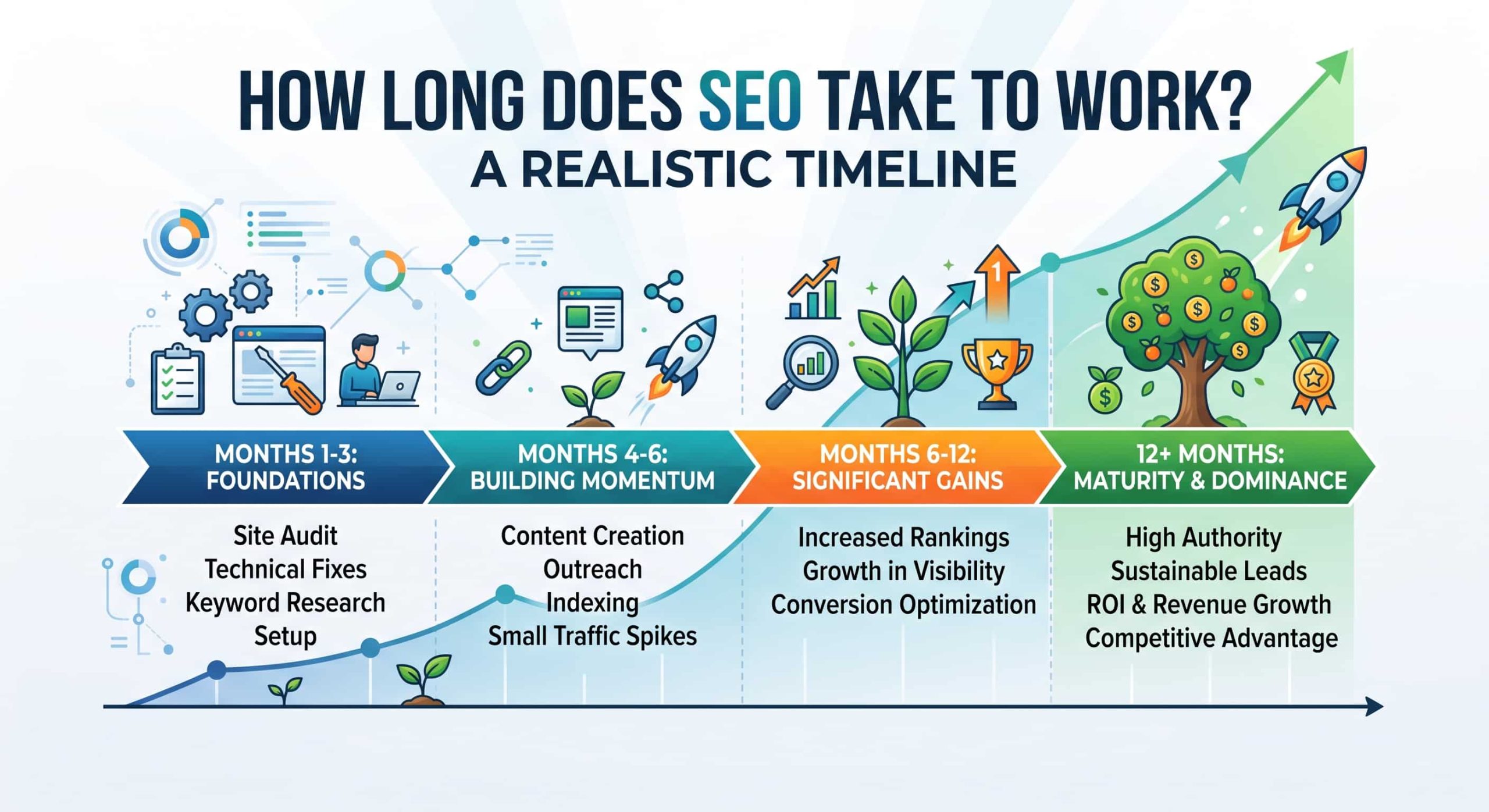
Search engine optimization is one of the most effective ways to build long-term organic visibility, attract qualified website visitors, and generate sustainable leads. However, one of the first questions almost every business owner asks before investing in SEO is simple: How long does SEO take to work?
The honest answer is that there is no universal timeline. Some websites can start seeing measurable improvements within a few weeks, while others may need six months, a year, or even longer to achieve significant organic growth. The timeline depends on factors such as the website’s current authority, technical condition, competition, content quality, search intent, backlink profile, industry, target keywords, and the resources available for SEO implementation.
For most established websites, SEO should be viewed as a medium- to long-term growth strategy rather than a quick marketing campaign. Early improvements may appear within the first few months, but meaningful increases in organic traffic, rankings, qualified leads, and revenue generally require consistent optimization and sufficient time for search engines to evaluate the changes.
In this guide, we will explain how long SEO takes to work, what you can realistically expect during each stage, which factors can accelerate or delay SEO results, and how to determine whether your SEO strategy is actually working.
How Long Does SEO Take to Work?
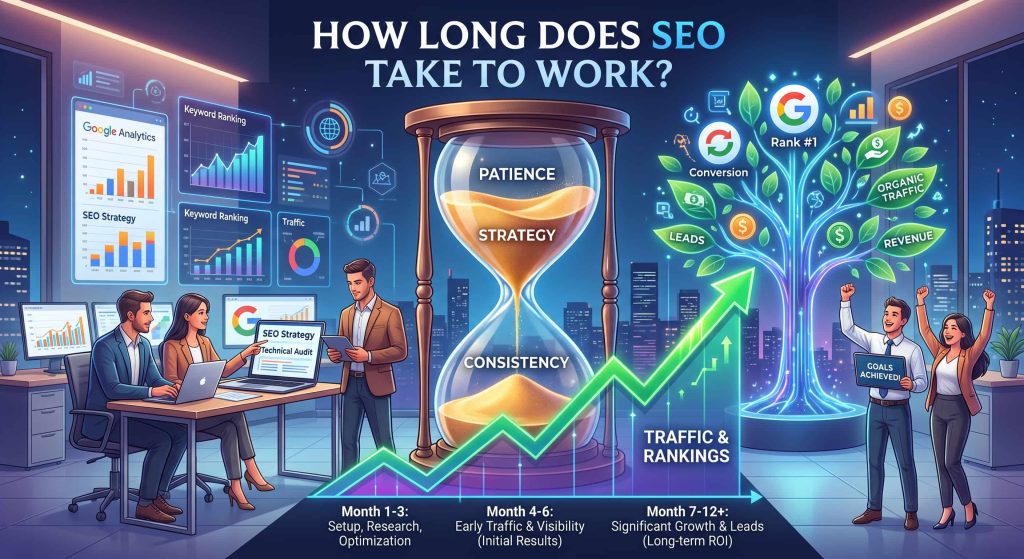
For most websites, noticeable SEO progress can begin within 3 to 6 months, while more substantial and consistent organic growth often takes 6 to 12 months or longer. However, this is not a fixed rule.
A newly launched website competing for highly competitive keywords may need significantly more time to establish authority. In contrast, an established website with strong backlinks, good technical foundations, and existing organic visibility may see ranking improvements much sooner.
It is also important to distinguish between different types of SEO results. Ranking improvements, impressions, organic clicks, leads, and revenue do not necessarily appear at the same time.
A website may begin receiving more impressions in Google Search within the first few months, while clicks and conversions increase later. This is why evaluating SEO based only on revenue during the first few weeks can create a misleading picture of performance.
A Realistic SEO Timeline
The following table provides a general framework rather than a guarantee:
| SEO Timeline | What You May See | Main SEO Focus |
| First 1–4 weeks | Technical discoveries and initial improvements | SEO audit, indexing, technical fixes |
| Months 2–3 | Increased impressions and early ranking movement | Content, on-page SEO, internal linking |
| Months 3–6 | More keyword rankings and organic traffic | Content expansion, authority building |
| Months 6–9 | Stronger visibility and qualified traffic | Competitive keywords, conversion optimization |
| Months 9–12+ | More consistent organic growth | Scaling successful strategies and ROI |
| 12+ months | Potential for significant authority and market visibility | Expansion, brand authority, advanced SEO |
These timeframes should be used as planning benchmarks rather than promises. SEO performance varies considerably from one website and industry to another.
Why Does SEO Take So Long?
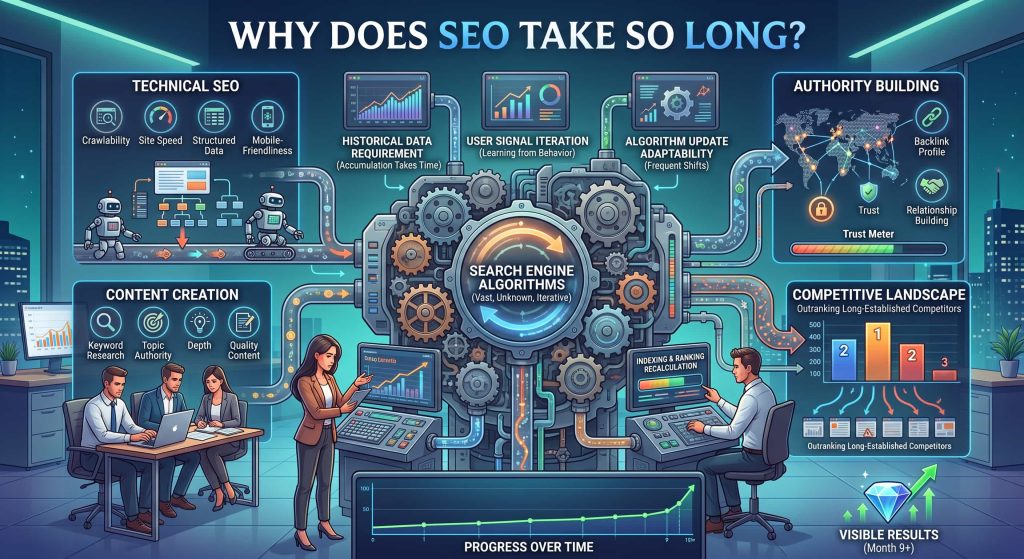
SEO takes time because search engines need to discover, crawl, index, understand, evaluate, and continuously reassess web pages. Improving a website does not immediately translate into higher rankings.
When you publish a new page or make a major technical change, Google needs to process those changes. It also needs to understand how the page fits into the broader topic, how useful it is compared with competing pages, and whether the website demonstrates sufficient authority and trust.
Competitive search results make this process even more complex. Your website is not being evaluated in isolation. It is competing against other websites that are also publishing content, improving their technical SEO, earning links, building brands, and satisfying users.
This means SEO is essentially a continuous process of improving your website while competing against an evolving search landscape.
Google Needs Time to Reevaluate Your Website
Search engines continuously crawl and process websites, but not every change is reflected immediately in rankings.
For example, suppose you identify a technical SEO problem that prevents important pages from being indexed correctly. Fixing the issue is an important first step, but the SEO impact may only become visible after Google recrawls and processes the affected pages.
Similarly, publishing a comprehensive article does not guarantee immediate rankings. Google must first discover and index the page and then evaluate its relevance and usefulness against existing search results. This is one reason why SEO should not be evaluated based on daily ranking fluctuations.
SEO Results Compound Over Time
One of the biggest differences between SEO and many forms of paid advertising is the compounding nature of organic growth.
A successful article can continue generating organic traffic months or even years after publication. Internal links can strengthen multiple pages, while a growing number of useful resources can increase the topical relevance of a website.
For example, a company that publishes ten high-quality pages targeting different aspects of a topic may eventually build a stronger topical ecosystem than a competitor that publishes one isolated article.
This compounding effect is one of the reasons businesses should evaluate SEO as an investment in an organic acquisition channel rather than simply another short-term marketing expense.
SEO Timeline: What Happens During the First 3 Months?
The first three months are often focused more on building the foundation than generating massive traffic. This does not mean that nothing happens during this period. In fact, some of the most important SEO work occurs before substantial traffic growth becomes visible.
Month 1: SEO Audit and Technical Foundation
The first month should usually focus on understanding the website and identifying the problems that could prevent organic growth.
A professional SEO audit may examine crawling and indexing, robots.txt, XML sitemaps, canonical URLs, redirects, duplicate content, URL structures, internal linking, Core Web Vitals, mobile usability, structured data, metadata, content quality, keyword targeting, and other technical factors.
At the same time, keyword research and competitor analysis should identify the search terms that actually have business value.
This stage is particularly important because creating large amounts of content before fixing fundamental SEO problems can lead to wasted resources.
Month 2: Content and On-Page Optimization
Once the most important technical issues have been addressed, the focus can shift toward content and on-page optimization.
Existing pages may need better search intent alignment, improved titles and headings, stronger topical coverage, clearer internal links, better content structure, and more useful information. New content can also be created around relevant keyword clusters.
The objective should not be to publish as many articles as possible. Instead, the goal is to create content that addresses real search needs and supports the website’s commercial objectives.
Month 3: Early Ranking and Visibility Signals
By the third month, some websites begin seeing early signs of progress. These may include increased Google Search impressions, more keywords appearing in search results, movement from lower positions toward the first or second page, and gradual increases in organic clicks.
However, early progress does not necessarily mean that the website is ready to generate a significant volume of leads.
At this stage, SEO professionals should analyze which pages and queries are showing traction and use that information to refine the strategy.
What Should You Expect After 3 to 6 Months?

The three-to-six-month period is often where SEO performance becomes easier to evaluate.
If the website has received consistent optimization and the strategy is aligned with the market, you may begin to see more noticeable growth in organic visibility.
Some keywords may reach page one, while others may move closer to competitive positions. Existing content may start generating more impressions and clicks, and newly published pages can begin contributing to overall organic traffic.
However, highly competitive commercial keywords may still require considerably more time.
Measuring SEO Progress Beyond Rankings
Rankings are useful, but they should not be the only SEO KPI. A website can improve its organic performance even when its primary target keyword has not reached the top position.
For example, a page might begin ranking for dozens of long-tail keywords that were not originally included in the keyword strategy. These additional rankings can generate highly relevant traffic and contribute to lead generation.
A more complete SEO measurement framework should therefore consider:
| SEO Metric | What It Tells You |
| Organic Impressions | How often your pages appear in search results |
| Organic Clicks | How much search traffic you receive |
| Keyword Rankings | How visible your pages are for target queries |
| Non-Brand Traffic | Visibility beyond existing brand searches |
| Organic Leads | Business opportunities generated from SEO |
| Conversion Rate | How effectively organic traffic converts |
| Revenue | Commercial impact of organic search |
| Indexed Pages | Whether important content is discoverable |
| Click-Through Rate | How effectively search visibility generates visits |
The most important metrics depend on the business model, but the ultimate objective should be connecting SEO performance to meaningful business outcomes.
What Happens After 6 to 12 Months?

For many businesses, six to twelve months is the period in which SEO can transition from an experimental channel into a meaningful acquisition engine.
By this point, a website that has been consistently improved may have a larger content footprint, stronger internal linking, more authority, better technical performance, and a larger number of ranking keywords.
The strategy can then become more sophisticated.
Instead of focusing only on easy keywords, the SEO team can begin targeting more competitive terms, expanding into related topic clusters, improving conversion rates, strengthening commercial pages, and building greater brand authority.
Scaling What Already Works
One of the biggest mistakes in SEO is continuing to produce content without analyzing performance. After several months of data, you should be able to identify which topics generate impressions, clicks, leads, and revenue.
Suppose a website publishes 50 articles but discovers that only 10 are consistently generating qualified traffic. The next step should not necessarily be publishing another 50 articles.
Instead, the SEO strategy could focus on updating successful content, creating supporting pages, strengthening internal links, improving conversion paths, and expanding the topic clusters that have demonstrated demand. This approach turns SEO from a publishing exercise into a data-driven growth strategy.
Factors That Affect How Long SEO Takes
There is no single SEO timeline because every website starts from a different position. Several factors can significantly influence how quickly a website achieves measurable results.
Website Authority
An established website with a strong backlink profile, recognizable brand, quality content, and existing organic visibility may have an advantage over a completely new domain. A new website generally needs to establish its credibility and topical relevance over time.
This does not mean new websites cannot rank. They can. However, the competitive environment and authority requirements for their target keywords have a major influence on the timeline.
Keyword Competition
Keyword difficulty is another major factor. Ranking for a highly competitive commercial query such as “digital marketing agency” can require significantly more authority and resources than ranking for a specific long-tail query.
Businesses should therefore avoid building their entire SEO strategy around a handful of extremely competitive keywords. A better approach is often to combine commercial keywords with relevant long-tail and topic-specific queries.
This creates opportunities for earlier wins while the website gradually builds the authority required for more competitive searches.
Website Size and Complexity
A small business website with 30 important pages is very different from an e-commerce website with 100,000 URLs.
Large websites can have complex crawling, indexing, faceted navigation, duplicate content, pagination, filtering, JavaScript rendering, and internal linking challenges. In these cases, technical SEO can have a significant impact on the timeline.
Content Quality
Publishing content is not enough. Search engines need to understand whether the content genuinely satisfies the user’s search intent.
A page that simply repeats information already available across hundreds of websites is unlikely to provide a strong competitive advantage.
High-quality SEO content should demonstrate subject knowledge, answer the user’s questions comprehensively, provide useful context, and help the reader take the next appropriate action.
Backlinks and Authority
Links remain an important part of how many websites build authority, particularly in competitive markets. However, link acquisition should be approached strategically rather than as a numbers game.
A smaller number of relevant, credible references can be more valuable than a large volume of low-quality or irrelevant links. The importance of backlinks also varies significantly by industry and competitive environment.
Technical SEO
Technical problems can delay SEO progress by preventing search engines from properly accessing, understanding, or indexing important content.
Issues such as incorrect canonical tags, accidental noindex directives, poor internal linking, broken redirects, server errors, duplicate URLs, crawl inefficiencies, and severe performance problems can all affect organic visibility.
This is why technical SEO should be considered part of the foundation rather than an optional task.
Does SEO Work Faster for an Existing Website?
Often, yes. An established website may already have indexed pages, backlinks, historical search data, organic traffic, brand signals, and existing rankings.
This provides an SEO team with more information and more opportunities to improve existing assets.
For example, a page ranking in position 11 may have a much shorter path to page one than a brand-new page targeting a highly competitive keyword.
Updating and improving existing content can therefore sometimes produce faster results than starting from zero.
However, an old domain does not automatically guarantee fast SEO results. If the website has significant technical problems, poor-quality content, weak authority, or a history of aggressive SEO practices, the situation can be very different.
Can SEO Results Be Seen in 30 Days?
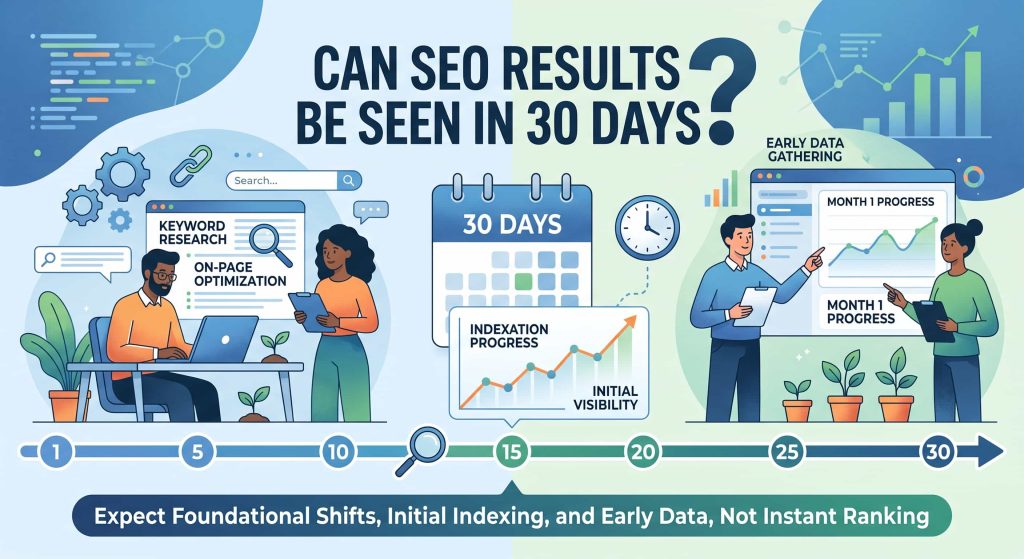
Yes, but expectations need to be realistic. Some websites can experience measurable SEO changes within 30 days, particularly when there are obvious technical problems or relatively easy optimization opportunities.
For example, fixing indexing problems can result in previously inaccessible pages becoming eligible for search visibility. Improving poorly optimized titles can also influence click-through rates.
However, expecting a new website to dominate competitive search results within 30 days is generally unrealistic.
The first month should primarily be viewed as a period for establishing the technical and strategic foundation.
Can SEO Take More Than a Year?
Absolutely. Some SEO campaigns require more than 12 months to achieve their full potential.
This is particularly common in competitive industries where established websites have strong domain authority, extensive content libraries, significant backlink profiles, and powerful brands.
International SEO can also require additional time because businesses may be competing across multiple markets, languages, and search landscapes.
In these situations, the right question is not simply “Why am I not ranking yet?”
A better question is:
“Are the leading indicators showing that the SEO strategy is moving in the right direction?”
If impressions, keyword coverage, organic clicks, qualified traffic, and conversions are consistently improving, the campaign may be progressing even if the most competitive keywords have not yet reached their target positions.
How to Know If Your SEO Strategy Is Working
SEO should be evaluated using trends rather than isolated snapshots.
Daily ranking fluctuations are normal. Search results can change because of algorithm updates, competitors, SERP features, personalization, location, device type, and many other factors.
Instead of checking rankings every day and reacting to every movement, businesses should evaluate performance over longer periods.
Leading and Lagging SEO Indicators
SEO metrics can broadly be divided into leading and lagging indicators.
Leading indicators can show that the strategy is gaining traction before major business results appear. These include increased impressions, improved keyword coverage, more indexed pages, better rankings for relevant queries, and increased organic clicks.
Lagging indicators include qualified leads, sales, revenue, and return on investment. Both are important because SEO often requires time before increased visibility translates into significant commercial outcomes.
When Should You Expect SEO to Generate Leads?
Traffic and leads are not the same thing. A website can receive thousands of visitors from search engines and still generate very few business opportunities if the traffic does not match the company’s target audience.
For lead generation, keyword strategy and conversion optimization are therefore just as important as traffic growth.
For example, a visitor searching for “what is SEO” may be interested in learning rather than buying. Someone searching for “SEO consultant for SaaS company” has a much stronger commercial intent.
This is why a professional SEO campaign should connect keyword research with the customer journey.
Aligning Search Intent With Business Goals
A strong SEO strategy usually includes informational, commercial investigation, and transactional queries. Informational content can build awareness and topical authority. Commercial content can help potential customers compare solutions, providers, and strategies. Service and landing pages can capture users who are ready to contact a business.
The combination creates a more effective organic acquisition funnel. Instead of asking only how much traffic an article can generate, ask:
Can this page attract the right person at the right stage of the buying journey?
That question often leads to much better SEO decisions.
SEO vs PPC: Why SEO Usually Takes Longer
One reason businesses become frustrated with SEO is that they compare it directly with paid advertising.
PPC can generate visibility almost immediately after campaigns are launched and approved. SEO generally requires more time because organic rankings are earned rather than purchased.
However, the two channels serve different strategic purposes.
Paid advertising can provide immediate traffic while a business builds its organic presence. SEO can gradually create an acquisition channel that does not require paying for every individual click.
For many businesses, the strongest digital marketing strategy is not choosing between SEO and PPC but understanding how the two channels can support each other.
How to Speed Up SEO Results
There is no legitimate shortcut that guarantees instant rankings. However, businesses can improve the efficiency of their SEO campaigns by focusing resources on the areas most likely to produce meaningful results.
The first priority should be removing technical barriers. The next step should be targeting realistic keywords based on competition and business value.
Existing pages with ranking potential should also be improved instead of focusing exclusively on new content.
Internal linking should connect related pages and distribute relevance throughout the website. Content should be built around topic clusters rather than isolated keywords.
Finally, performance should be measured continuously so that resources are invested in strategies that demonstrate actual results.
Focus on High-Opportunity Pages
One of the fastest ways to improve SEO efficiency is identifying pages that are already close to achieving stronger rankings.
For example, a page ranking around positions 8–20 for a commercially valuable keyword may represent a significant optimization opportunity.
Improving its content, search intent alignment, internal links, title, user experience, and authority signals can sometimes be more efficient than creating an entirely new page.
This is where Search Console data becomes particularly valuable because it can reveal queries and pages that are already receiving impressions but have untapped potential.
Common SEO Mistakes That Delay Results
Some SEO campaigns take longer than necessary because resources are invested in the wrong areas. One common mistake is constantly changing the strategy before giving previous work enough time to produce meaningful data.
Another is targeting keywords that are far too competitive for the website’s current authority.
Publishing large amounts of low-value AI-generated or repetitive content can also create a large website without creating meaningful topical value.
Technical issues are another frequent problem. A business may invest heavily in content while important pages remain poorly indexed or difficult for search engines to crawl.
Finally, focusing exclusively on rankings can cause businesses to ignore the actual goal: generating qualified traffic, leads, customers, and revenue.
How Long Does SEO Take for a Small Business?
Small businesses can start seeing meaningful SEO progress within a few months, but the exact timeline depends heavily on the local or national competition, website quality, industry, available resources, and target keywords.
For a small business operating in a relatively low-competition market, reaching valuable rankings can happen faster.
A small business competing nationally against major brands may require a significantly larger investment and longer timeframe.
The best approach is to create a staged strategy. Early efforts should target realistic opportunities while gradually building the authority needed to compete for larger keywords.
How Long Does SEO Take for a New Website?
A completely new website usually needs more patience. Because it has little or no historical organic visibility, backlinks, content depth, or established authority, it needs to build these signals over time.
The first few months should focus on creating a technically sound website, establishing the site’s core topic areas, publishing genuinely useful content, and earning relevant authority.
Rather than measuring success only by whether the website ranks for its biggest keyword, early-stage SEO should track whether the site’s overall search visibility is expanding.
A growing number of indexed keywords, impressions, clicks, and relevant landing pages can indicate that the website is establishing a foundation for future growth.
A Realistic 12-Month SEO Roadmap
A practical SEO campaign can be divided into several stages:
| Period | Primary Objective | Typical Activities |
| Month 1 | Build the foundation | Technical audit, keyword research, analytics, indexing |
| Months 2–3 | Fix and optimize | Technical fixes, on-page SEO, content optimization |
| Months 3–4 | Build relevance | Topic clusters, internal linking, new content |
| Months 4–6 | Increase visibility | Content expansion, authority building, CRO |
| Months 6–9 | Scale winners | Content updates, competitive keywords, stronger commercial pages |
| Months 9–12 | Drive business growth | Lead generation, conversion optimization, ROI analysis |
| 12+ months | Expand authority | New markets, advanced content, digital PR, competitive expansion |
This roadmap should be customized for the business rather than followed mechanically.
An e-commerce website, SaaS company, local business, law firm, healthcare organization, and international B2B company can all require very different SEO strategies.
How Much Should You Invest in SEO Before Expecting Results?
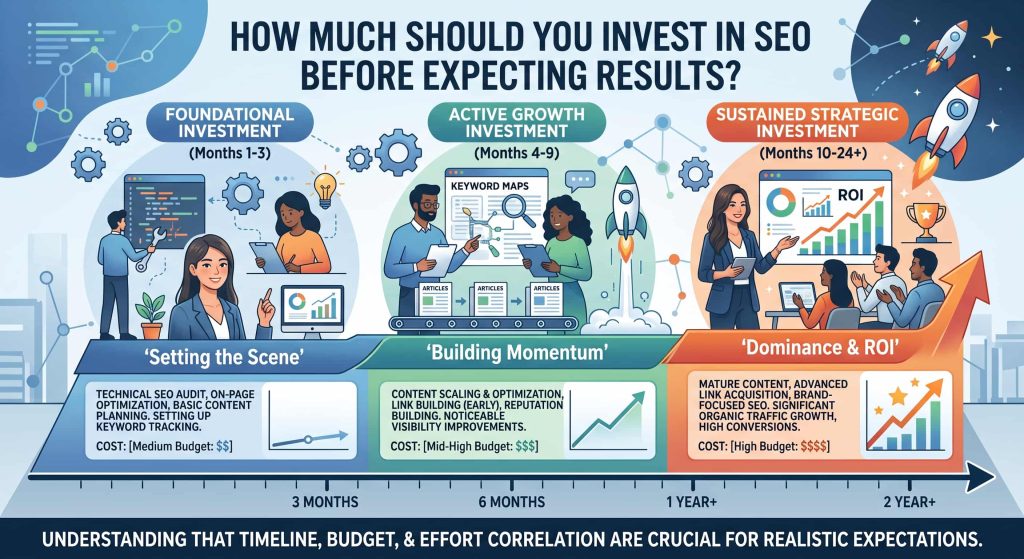
SEO investment should be based on the opportunity and competitive environment rather than a universal monthly figure.
A local business targeting a limited geographic area may need a relatively focused campaign. A national e-commerce brand competing for thousands of commercial keywords may require a much larger SEO operation.
The key is consistency.
A campaign that receives significant resources for one month and then stops may produce less value than a structured campaign that consistently improves the website over a longer period.
SEO is not simply an expense for content production or link building. A complete SEO investment may include technical development, content strategy, copywriting, digital PR, analytics, conversion optimization, and ongoing strategic analysis.
Final Answer: How Long Does SEO Really Take?
So, how long does SEO take to work?
For many websites, the first measurable signs of progress can appear within 1 to 3 months, more noticeable growth often develops around 3 to 6 months, and substantial organic growth commonly requires 6 to 12 months or more.
But these numbers should never be treated as a guarantee.
The actual SEO timeline depends on where the website starts, how competitive the market is, the quality of the strategy, the technical condition of the website, the quality and depth of its content, authority signals, search intent, and the consistency of implementation.
The most important thing is to avoid thinking of SEO as a campaign with a fixed finish date.
A successful SEO strategy is an ongoing growth process. The objective is not simply to reach position one for a keyword. The objective is to build sustainable search visibility that attracts the right audience, generates qualified leads, supports conversions, and ultimately contributes to business revenue.
For businesses investing in SEO, the most useful question is therefore not “How quickly can we rank?”
It is:
“How can we build an organic growth system that becomes more valuable over time?”
That shift in perspective creates a much more realistic and sustainable approach to SEO.